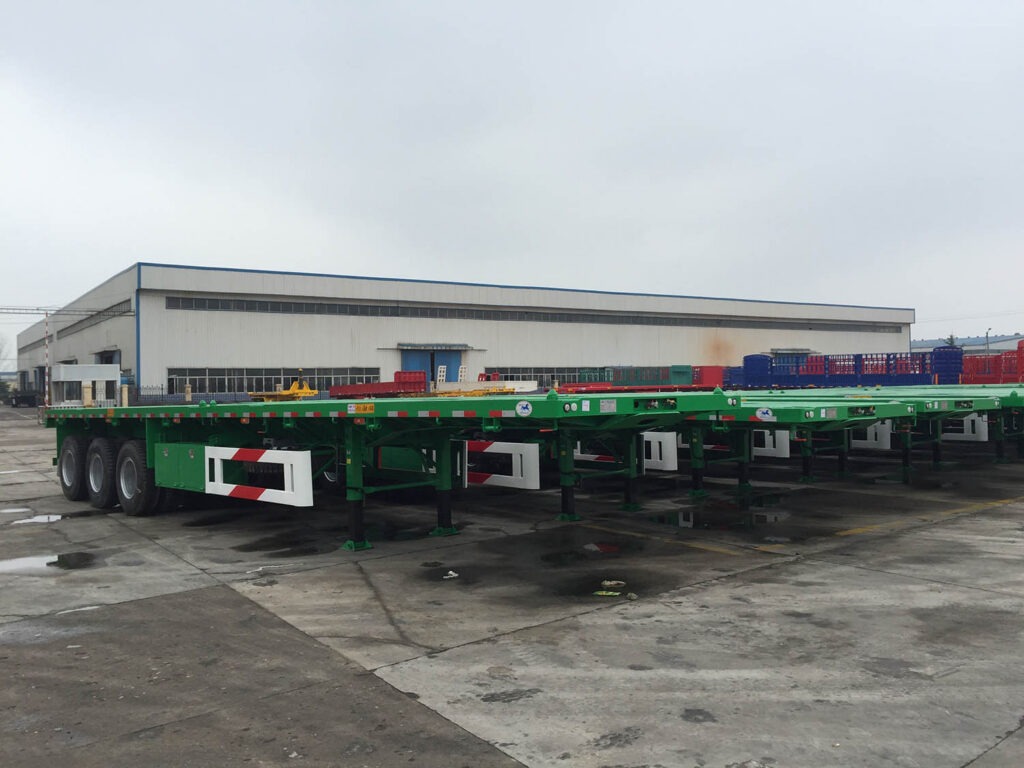
A useful flatbed-versus-lowbed comparison starts with the cargo and loading method. The Vehicle Master catalogue treats them as distinct families, with different applications and configuration options.
Start with the cargo
Flatbed catalogue applications include container transport and general cargo. The lowbed section focuses on heavy equipment, construction vehicles and heavy cargo. Send the cargo dimensions and mass before narrowing the model list.
Compare the loading arrangement
The flatbed specification separates 20ft, 40ft and 45ft configurations and their container arrangements. The lowbed specification lists mechanical-spring or hydraulic ramps, detachable-gooseneck availability and covered or uncovered tyre arrangements. These are options to discuss, not equipment automatically included with every product.
Read capacity ranges in context
The lowbed reference lists 30–120 tons for the 3-axle configuration and 30–150 tons for the 4-axle configuration. The flatbed ranges vary with configuration. A range in the catalogue is not a fixed rating for every trailer sharing that axle count.
Prepare a configuration enquiry
Include cargo dimensions, loaded weight, wheel or track spacing, loading equipment and destination. Confirm the complete vehicle dimensions and applicable requirements for your operation; this comparison does not establish a route permit or approval.
Technical basis: Vehicle Master Product Catalog 2025, PDF pages 10–15. This guide summarizes catalogue configurations. Confirm the final specification and documents for your selected order.
Compare trailer models or send your cargo and configuration requirements.