Every fence semi trailer order that comes through Vehicle Master’s sales desk kicks off the same way: not with a flip through the product catalogue, but with three key questions from the buyer. How heavy will the loads be? What exactly gets hauled? And what sort of roads will the trailer call home for the next ten years?The answers do more to shape the final build than any brochure spec sheet — so this article works through the fence semi trailer lineup the same way an order takes shape, decision by decision.
Decision One: How Heavy Is the Load?
Everything starts from payload, because it fixes the axle count and from there the whole chassis. The range steps through three ratings:
| Configuration | Loading Capacity | Typical Loads |
|---|---|---|
| 2-axle fence trailer | 20–40 t | Farm produce, palletised cargo, light machinery |
| 3-axle fence semi trailer | 30–60 t | Livestock, bagged grain, construction materials |
| 4-axle fence trailer | 40–100 t | Heavy machinery, dense bulk cargo, mining supplies |
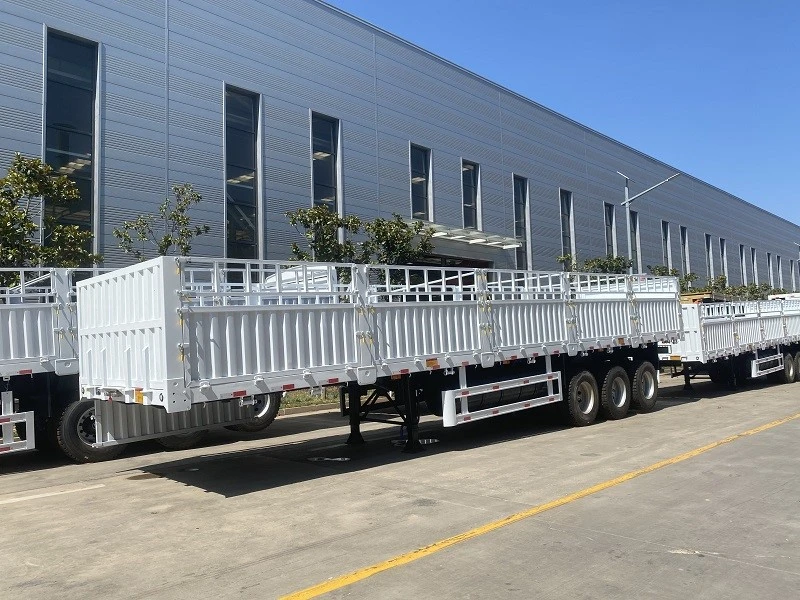
In practice, regional buyers converge on the middle step. The 3-axle 30–60 t rating matches both axle-load enforcement and the towing capacity of the tractors most fleets already run, which is why it anchors the lineup. The 82-unit programme delivered to Ethiopia followed exactly this logic: fence units at the 3-axle rating for general cargo, working alongside tippers rather than replacing them. When a buyer’s answer to this first question pushes past 100 t, the honest recommendation stops being a fence trailer altogether — machinery of that class moves on a lowbed, as the 20 lowbed units sent to Ghana illustrate.
Decision Two: What Are You Hauling?
Same chassis, three different working lives. This is where a fence trailer stops being a generic flatbed with rails and becomes a task-specific machine.
Cattle, goats and sheep.For livestock transport, this model comes with internal dividing gates that split the deck into separate pens. This keeps animals in smaller, calmer groups rather than letting them all surge forward against the front wall during braking.The 3-axle 48 ft configuration — one of the most popular livestock builds in our lineup — combines these dividers with slatted ventilation gaps in the side rails, a non-slip floor surface, and multiple entry/exit doors for safe, controlled loading and unloading.
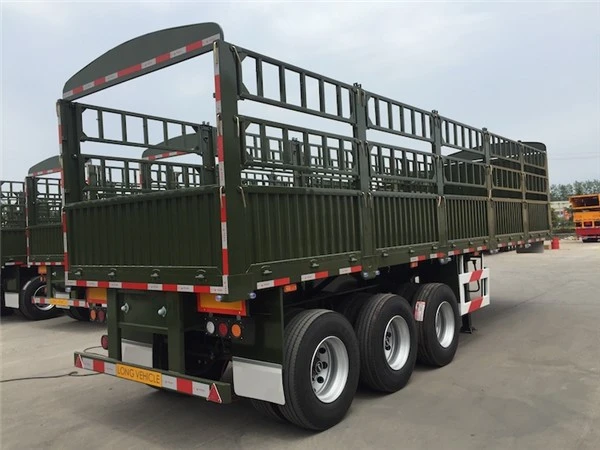
Bagged and loose cargo. Grain, cement, feed and produce travel in the open rail configuration — and when the season turns wet, a canvas or side-curtain over the fence rails keeps the load dry without giving up the open-rail option for the next machinery run.
Machinery and long goods. For excavators, gensets and steel pipe, the rails themselves come off. The fence body is built from removable rails on hinged pins, converting the trailer to half-wall or full flatbed duty with hand tools in minutes — a deliberate design choice, since a unit that hauls cattle on Monday and steel pipe on Thursday earns its keep twice over. The batch of 3-axle fence semi trailers shipped to Mozambique went to a general-cargo fleet running exactly this mixed-duty pattern.
Decision Three: What Roads Will It Actually Run?
Your route conditions dictate the undercarriage spec. The main beams are welded from Q345 or T700 high-strength steel, and we scale the beam thickness with axle load instead of using a one-size-fits-all design: the upper flange plate is 12mm for 2- and 3-axle models, and 18mm for the 4-axle version, with a consistent 6mm web plate across the range.For fleets running mixed routes — paved highway up to the border, then graded gravel roads beyond — the gooseneck option is a popular add-on, giving a lower loading deck height and more stable weight distribution. Axle brand (VEHICLE MASTER, FUWA, BPW or others), tire brand, fence height, floor type and paint finish are all matched to your real operating conditions, not locked to a fixed build sheet.
From Spec to Delivery: The Cooperation Side
One more decision sits outside the trailer itself: how it arrives. Distributors can run the fence trailer under their own branding through OEM production, and regional assemblers can import it in CKD or SKD kits for local assembly — a route that cuts import duties and lead time in several African markets, as covered in our CKD and SKD cooperation overview. The full specification set and enquiry channel are on the fence semi trailer product page — bring the three answers, and the configuration follows.