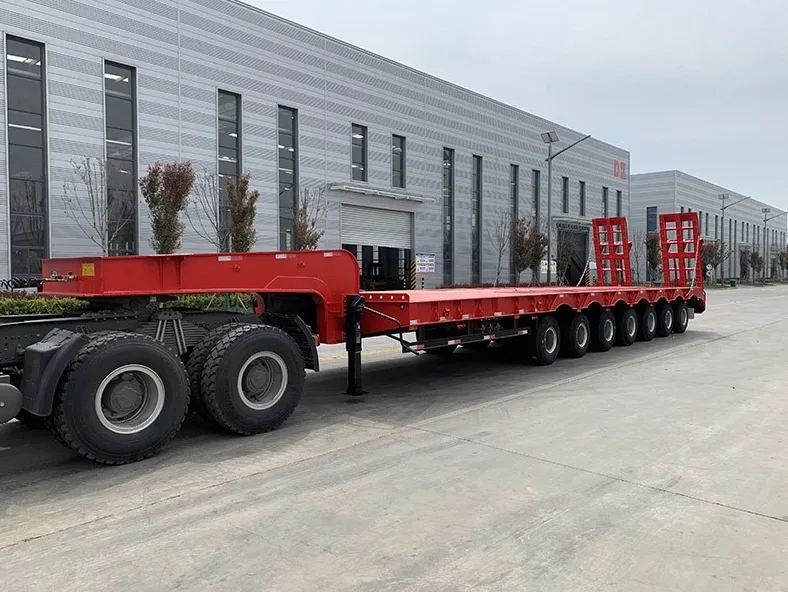
Every week the same question lands in our inquiry inbox: “I need to move 100 tons — how many axles should the trailer have?” It is the right question to ask first, because on a 100 ton lowbed semi trailer the axle count is not a detail. It determines your deck length, the routes you are permitted to travel, your annual tire replacement needs, and above all else, the overall cost of your investment.
This guide walks through the way seasoned fleet buyers actually spec a heavy haul trailer before they ask for a quotation: three sums first, then the chassis, then the price. Work through them in order and the configuration almost writes itself.
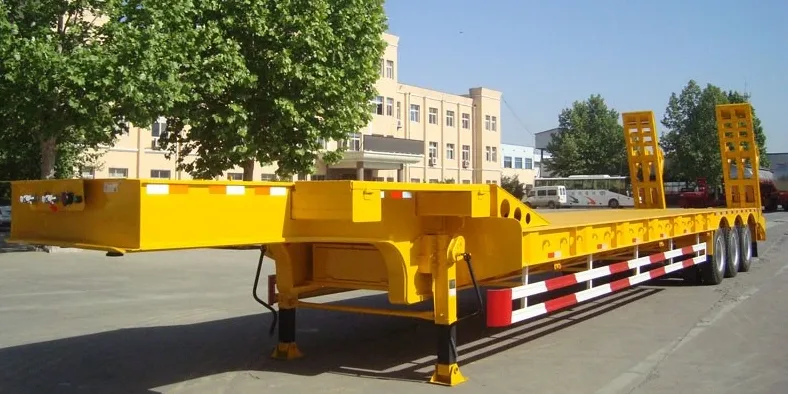
Sum One: How 100 Tons Sits on the Axles
ach axle of a heavy lowbed trailer carries a load rating between 13 and 16 tonnes. FUWA and BPW serve as the two standard brands widely accepted by fleet operators across Africa and Latin America. The axle configuration is built around this rating, and this is why there is no single fixed specification for a “100-tonne” capacity unit:
| Axles | Working payload | Typical deck | What it fits |
|---|---|---|---|
| 2 axles | up to ~30 t | short 10–13 m | single machines, mid-size excavators |
| 3 axles | 60–80 t | 13–16 m | one heavy excavator or two machines |
| 4 axles | 80–100 t | 13–16 m | concentrated 100 t loads, standard hauls |
| 5 axles | 100 t | 13–16 m | 100 t with margin, harsher routes |
| 7 axles | 100 t + long loads | 15–20 m | steel structures, long plant equipment |
The mistake first-time buyers make is reading the table top-down and picking the cheapest row that says “100”. The correct way is to start from the machine: a 100 t excavator concentrates its weight on tracks within a few meters, so four or five axles under a custom axle configuration carry it comfortably. A 60-ton steel girder spread over 18 meters is lighter per meter but needs the long deck of a 7 axle lowbed — see the dedicated 7 axle lowbed builds — where 16–24 tires share the load, axles can be hydraulic or self-steering to survive tight site corners, and the deck can even stretch on extendable frames.
Pose this straightforward question to your supplier: what is the permitted axle load along the corridors you will operate on? Bridge calculation rules and single-axle weight limits vary widely across Kenya, Zambia and West Africa. Your trailer should be specified to meet the strictest regulations on its travel route, not just average requirements. Our Kenya-spec lowbed page shows how one market’s rules translate into a build sheet.
Sum Two: The Deck Dimension Budget — Length, Width & Height
Once the axle count is fixed, the deck follows. Heavy lowbed decks run 12 to 18 meters long and 2.5 to 3.5 meters wide — wider decks need permits on most corridors, so buy width only when the cargo demands it.
The spec that decides more purchases than any other is platform height: 850 to 1200 mm. A low platform is not a comfort feature; it is legal headroom. A 3.6-meter-tall excavator on a 1200 mm deck clears the 5-meter overhead limits of most power lines and gantries. On a taller deck the same machine needs escorts or a different route. The full route-limit math — bridge heights, lane widths, axle ceilings — is laid out in our semi trailer dimensions guide, and it applies doubly at 100 tons.
Two deck decisions belong in every heavy haul quotation:
- Gooseneck — fixed or detachable. A fixed neck is simpler and cheaper. A detachable gooseneck drops to the ground so machines with low ground clearance drive on at near-zero angle — the standard choice for loading large excavators without ramps. For mixed fleets deciding between deck heights altogether, our flatbed trailer types comparison explains where standard decks stop and low decks begin.
- Ladders or Ramps: Spring mechanical ladders come at lower cost and stand up to heavy use, while self-raising hydraulic ramps ease the workload for staff. A 100 ton lowbed with ladder spec is the most common compromise East African fleets choose.
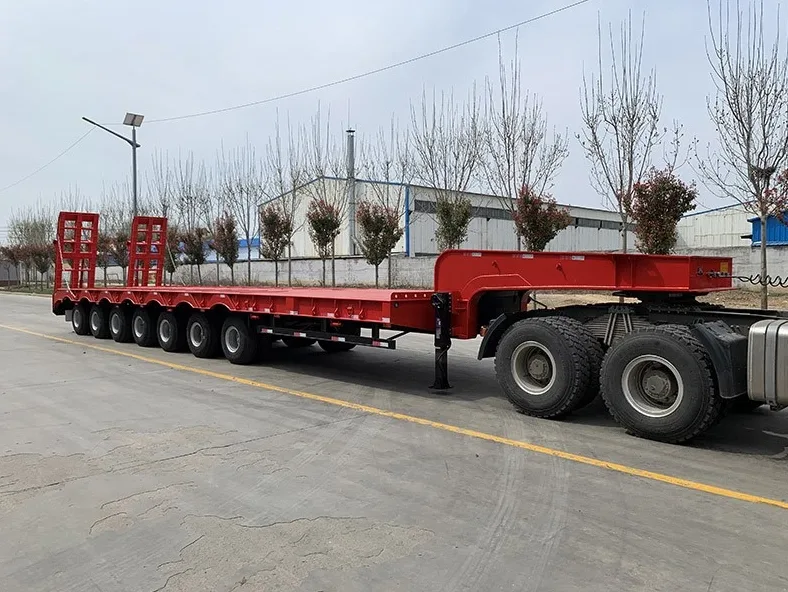
Sum Three: The Chassis Account — Suspension, Steel and the Parts You Will Actually Replace
The frame under everything is the part you never see again after delivery, so spec it once, properly: Q345/T700 high-strength steel, I-section main beams welded by automatic submerged-arc — machine welds, not hand passes, because a 100-ton frame is only as good as its longest weld.
Everything else on the chassis is a running-cost decision:
- Suspension. Leaf spring options: 90 mm springs with 13/16 leaves (ten per stack) withstand rough mine roads and are inexpensive to repair. Air suspension shields costly loads on surfaced roads. Hydraulic suspension sits under the heaviest custom builds where load equalization across axles matters. Rule of thumb from our build records: the worse the road, the more sense mechanical makes.
- Tires. 12R22.5 or 8.25R20, four per axle — on a 7-axle trailer that is 28 tires rotating through your maintenance budget. Choose brands your local dealers actually stock.
- The hardware that outlives the trailer. A #50 (2″) king pin for standard prime movers, #90 (3.5″) for heavier service; JOST 28-ton two-speed landing gear; air brakes with optional ABS. These are the items roadside workshops across Africa know how to service — stick to the names they recognize.
The Price Account: What You Get Within the $15,000–$30,000 Budget
A 100 ton lowbed semi trailer from the factory starts between $15,000 and $30,000, and the spread is almost entirely explained by the three sums above: axle count is the biggest single lever, then deck length, then the gooseneck and ramp choices. Hydraulic steering axles and air suspension push a build toward the top of the band; a fixed-neck 4-axle standard deck sits near the bottom.
To receive a fixed quotation from the manufacturer, provide five key details: cargo type and weight, cargo dimensions, travel routes and applicable restrictions, loading method (ramps, ladder or detachable neck), and destination port. Buyers who skip the axle conversation and ask only “100 ton trailer price” get quoted the safest — and most expensive — configuration. If you are weighing a 4-axle 120-ton excavator build against a 30–150 ton gooseneck lowbed, the same five answers decide it in one round.
Hand those five specs to our engineering team through the inquiry form and you will get a configuration sheet with the axle math shown — not just a price.
Hauling 100 tons and need a properly engineered configuration? Tell us the machine, the route and the loading method — WhatsApp or the contact form — and Vehicle Master will return a spec sheet with the axle count, deck height and suspension matched to your corridors, at factory price.