When a fleet manager reaches out to our sales team saying “I need a flatbed trailer,” the discussion that follows is seldom about the trailer itself. It centers on the cargo it will carry.How tall is it once loaded? How much does it weigh? Does it roll up a ramp or get lifted by a crane? The answers quietly select one of four very different deck types — and the factory quote only makes sense once that selection is made.
That is the piece most buying guides skip. Flatbed trailer types are not a catalog of unrelated products; they are one chassis logic applied to different height budgets, axle counts and loading methods. Once you see the logic, the spec sheet reads itself.
The Standard Flatbed Deck: The Benchmark All Others Are Judged Against
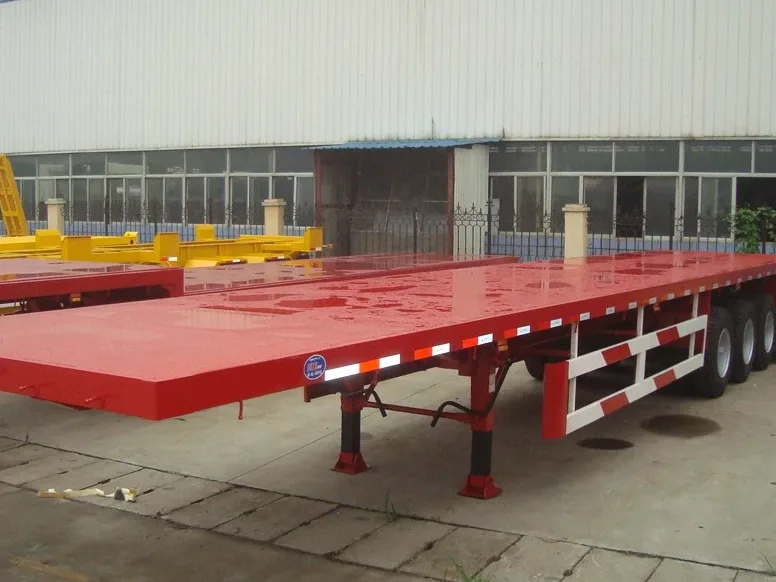
A standard flatbed semi trailer carries its load on a flat steel deck sitting at container-floor height — high enough to clear the tires and suspension underneath. In our line it spans 20 to 60 feet in length on 2, 3 or 4 axles, covering payloads from 20 to 80 tons, with FUWA or BPW axles rated at 13 or 16 tons each. The main beam is Q345/T700 high-strength steel, joined by automatic submerged arc welding and protected by electrophoresis painting — the same baseline spec that runs through every variant in this article.
The standard deck wins whenever the cargo can be stacked, craned or stays inside its own height budget: steel beams, pipes, timber, container moves, machine tools on crates. Take the 48 ft flatbed as an example: it is 102 inches wide, with an overall height of 13 feet 6 inches and a 48,000 lb load rating for the tandem-axle configuration. These dimensions are optimized for North American road restrictions. Similarly, shorter flatbed decks are engineered for the routes African fleets commonly operate on, where the 30 ft flatbed continues to be a top repeat-order model.
One detail turns a standard flatbed into a container platform: twist locks. Our decks take 4 or 12 sets, so the same trailer that hauls break-bulk cargo on Monday locks a 20 or 40 foot container down on Tuesday. Buyers searching for a container flatbed are usually looking at exactly this configuration.
The Height Budget: Why Drop Deck Trailers Exist
Every route has a legal maximum height — and the number that matters is not the height of your machine, but the height of your machine plus the deck it rides on. That sum is the height budget. A standard flatbed deck sits at container-floor level; if the cargo is tall, the budget breaks, and the fix is not a smaller machine but a lower deck.
A drop deck trailer answers by dropping the main deck between the wheel arches, cutting the loading height by roughly half a meter against a standard flatbed. The gooseneck sits high above the tractor fifth wheel, preserving the tractor’s bridge clearance. On a single-drop deck, the platform descends only once behind the gooseneck. A double-drop flatbed has two drop points, front and rear, forming a short, very low centre well. Thanks to this middle recess, double-drop units are widely used to transport oversized tall loads that cannot be taken apart, including presses, transformers and vertical tanks.
The trade-offs are real and worth quoting honestly: the dropped sections reduce usable deck length for long cargo, loading usually needs ramps or a dock, and the low deck asks for careful route planning around ground clearance. For many hauliers the deciding question is simply whether the cargo’s height, plus deck, exceeds the corridor limit — if it does, no amount of standard flatbed will pass the bridge.
Lowbed: When “Flatbed” Really Means Heavy Equipment
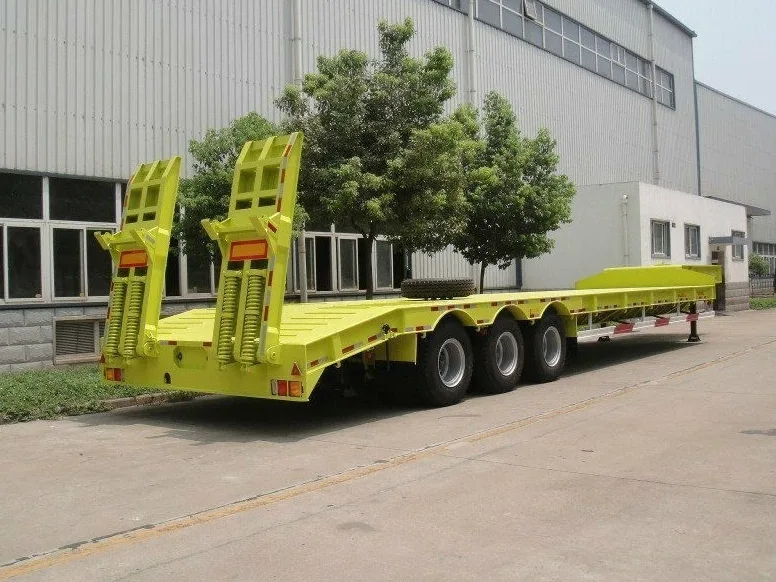
Searches for flatbed types overlap heavily with excavator transport, and that is the lowbed’s home ground. Our lowbed family runs 3 or 4 axles at 30 to 120 tons — up to 150 tons in multi-axle trim — on decks around 13,000 × 3,000 mm with overall height engineered down to 1,760 mm. The main beam is a 500 mm Q345/T700 box section with plates up to 24 mm top and 26 mm bottom, because a low deck carrying an excavator cannot be allowed to flex like a standard flatbed.
Loading method is where lowbeds diverge from everything above. A mechanical spring or hydraulic ladder unfolds at the rear so machines climb under their own power — no crane, no dock, which matters on mine sites and remote projects. A detachable gooseneck lowbed goes further: the front disconnects entirely, the machine drives straight onto the deck from ground level, and steering axles keep tire wear survivable when the payload tops 100 tons.
The classic flatbed vs lowbed comparison comes down to height and weight together. Standard cargo that fits the height budget rides a flatbed; heavy machinery that breaks it rides a lowbed. Everything in between is a drop deck decision.
The Axle Question: That Key Number in Your Quote
Once the deck type is settled, payload sets the axle count. On our flatbed line, 2 axles carry the 20–40 ton classes, 3 axles cover 30–60 tons and 4 axles take the 40–80 ton range; lowbeds scale the same logic upward with 13 or 16-ton axles, steering options and multi-axle layouts beyond 100 tons — the logic that also underpins heavy combinations like the 80-ton superlink flatbed running southern African corridors. Tire counts follow at 8, 12 or 16 pieces of 12R22.5, and the undercarriage standards hold constant across types: JOST 28-ton two-speed landing gear and 2″ or 3.5″ king pins.
This explains why we discuss axles second, not upfront. While a 4-axle standard flatbed and 4-axle lowbed carry the same axle specification, they are built for different cargo requirements. Confirming axle count prior to deck type often leads to selecting the wrong trailer.
One Chassis, Many Trailers: The Flatbed Configurator Logic
Here is the part that saves fleet managers the most money: flatbed variants are configurations, not separate vehicles. The same base chassis that leaves the line as a standard flatbed can carry side walls for bagged and mixed cargo, a fence structure for livestock and light freight, or full twist-lock sets for container duty. Stake pockets and lashing points are punched into the deck, so a single trailer reconfigures between contracts instead of sitting idle.
It is also why our buying conversations move quickly once the three questions are answered. Deck type, axle count and loading method pin down 80 percent of the spec sheet; the rest is length, brand preferences on axles and landing gear, and the route rules of the destination country.
What to Send Before You Ask for a Flatbed Quote
Whether you’re evaluating different flatbed trailers for an upcoming contract or looking to replace an existing unit that can no longer handle your cargo, our team relies on five key details to prepare an accurate quotation: the type of goods, loaded dimensions and total weight, loading method (crane, ramp or self-propelled), order quantity, and target export market.Hand those to our engineering team through the inquiry form or by WhatsApp, and the deck decision comes back with numbers attached, not guesses.
Choosing between a standard flatbed, a double drop or a lowbed? Send your cargo details through our inquiry form or message us on WhatsApp — we will match the deck type, axle count and loading system to your route in one reply.