This enquiry landed on a Tuesday morning, just like most excavator requests: a photo of the machine, its model number, and a single line — “80-ton excavator, need a trailer, what can you supply?” Before talking pricing, our quotation team responds with a different question: how many axles do you really require? For an 80-ton excavator, that answer is calculated, not guessed. It comes out of the trailer axle capacity math that runs through every lowbed order we build, and getting it right is the difference between a trailer that clears your bridges and one that becomes a very expensive yard ornament.
This post walks through that exact order the way we process it: the machine first, the axle math second, then the details that move the axle count up or down. If you are comparing quotes from different factories right now, it will also explain why two trailers that both claim “80 tons” can sit at different price points — and why that difference is legitimate.
Start With the Machine, Not the Trailer
An 80-ton-class excavator rarely weighs exactly 80 tons on transport day. The weight listed on the nameplate refers to the excavator’s operating weight: it includes the main chassis, cab, counterweight, fuel, hydraulic oil and a standard operator. What this rating often does not account for is all the site attachments you fit later — upgraded counterweights, long-reach booms, hydraulic breakers, extra track pads for soft terrain, buckets and spare parts carried together. Any of these extras can add several tonnes before the machine even drives onto the trailer deck.
Then there is the machine’s shape. An 80-ton excavator with the boom folded sits tall; with the arm detached it sits narrower but longer. Track frames can be widened for transport or locked narrow for loading. Each of these choices changes where the load lands on the deck, which changes the load on each axle line — so the number we spec for is rarely the number printed on the nameplate. When the machine arrives heavier or wider than the order assumed, the trailer does not fail dramatically; it just wears tires unevenly, sags on one axle group, and quietly burns through its service life.
Axle Capacity Calculation: 80-Ton Excavator Trailer
Here is the calculation that settles it. Lowbed trailers are built on axle lines rated at 13, 16, or 20 tons each — the FUWA and BPW axles we fit on every excavator trailer. Multiply the per-line rating by the number of lines and you get the deck’s rated capacity:
| Axle Lines | 13 t / line | 16 t / line | 20 t / line |
|---|---|---|---|
| 2 axles | 26 t | 32 t | 40 t |
| 3 axles | 39 t | 48 t | 60 t |
| 4 axles | 52 t | 64 t | 80 t |
Read that bottom-right cell and the spec for this order explains itself: 4 axle lines × 20 t = 80 tons. That is exactly why our 4 axle 80 ton lowbed trailer for excavator ships with 13/16/20-ton FUWA/BPW axle options and a double-layer reinforced main beam — the axle lines and main beam are rated as a complete assembly rather than individual components. This trailer is also fitted with 16 tires — either 12R22.5 or 8.25R20. Distributing the 80‑ton load across sixteen tyres keeps ground pressure and single-tire loads within safe limits, extending tyre service life
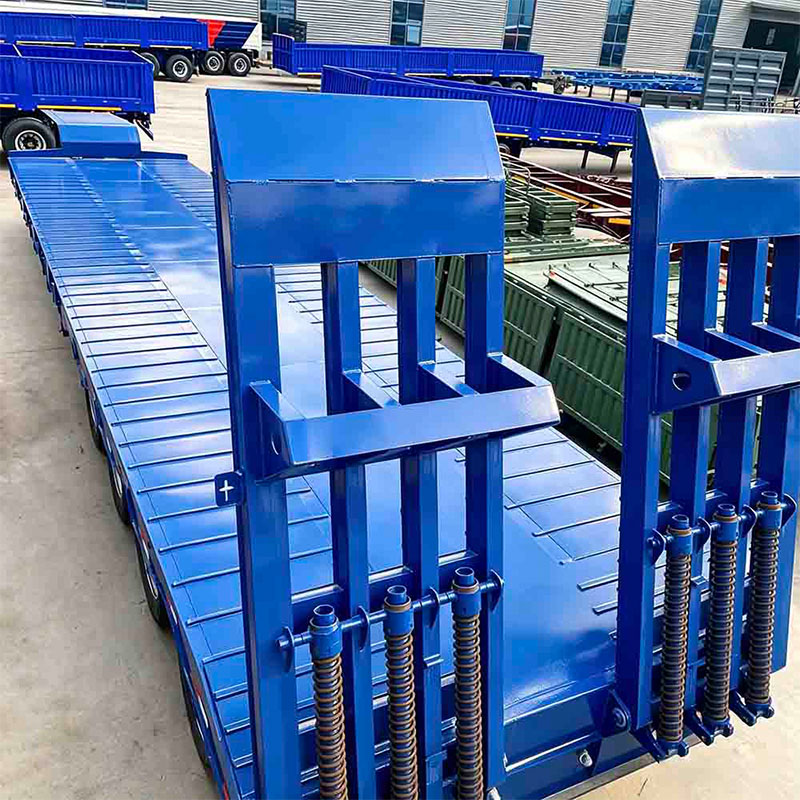
One warning for anyone comparing quotes: the per-line rating is the spec that matters, not the axle count alone. Two 4-axle trailers can be built with 13-ton lines or 20-ton lines, and only one of them is genuinely an 80-ton trailer. If your route includes bridges with per-axle limits — common across mining corridors in Africa, the Middle East, and Southeast Asia — ask the factory to state axle load per line in writing, exactly the way we break it down in our 100 ton lowbed semi trailer buying guide for the next weight class up. The same principle holds: the price is set by the axle math, so the math belongs on the quotation.
Three Axles or Four? The Trade-Off Behind the Same 80-Ton Rating
Our catalog lists both a 3 axle 80 ton lowbed trailer and the 4-axle build, and customers regularly ask why we would offer two answers to the same number. The explanation is that an 80-ton load capacity can be achieved through multiple engineering solutions. The most suitable option hinges primarily on your road conditions, not the excavator itself.
| 3-Axle 80 t Build | 4-Axle 80 t Build | |
|---|---|---|
| Tires | 12 | 16 |
| Per-line path to 80 t | Higher-rated lines (up to 20 t) plus gooseneck load transfer | 4 × 20 t lines carry the full rating on the deck |
| Ground footprint | More concentrated | More spread out — better on soft mine roads |
| Turning behavior | Tighter, easier on congested sites | Slightly longer wheelbase |
| Bridge-limit compliance | Harder where per-axle limits are strict | Easier — lower load on each line |
In practice, fleets running soft plantation or mine roads choose the four lines because the load spreads wider; fleets that work tight urban or yard environments sometimes prefer three lines for the turning radius, and accept the higher per-line load. Both builds share the same deck — 13,500 mm long, 3,000 mm wide, expandable to 4,500 mm with folding widening sections — and both sit on the same 80 ton 3 axle lowbed trailer platform family, so the choice is about axle count, not deck quality. If you are weighing the decision across a whole fleet rather than a single order, our 4 axle lowbed lineup walkthrough shows how the same axle count ships at different ton ratings.
How Excavator Specs Alter the Calculation
The axle math settles the count, but the machine itself keeps editing the spec. Four details matter on almost every 80-ton excavator order:
- Track width. Wide-track frames or bolted-on extension shoes can push the machine past 3,000 mm. Folding widening components take the deck to 4,500 mm so the tracks sit fully on steel — an overhanging track edge loads the deck edge and the outer tires unevenly.
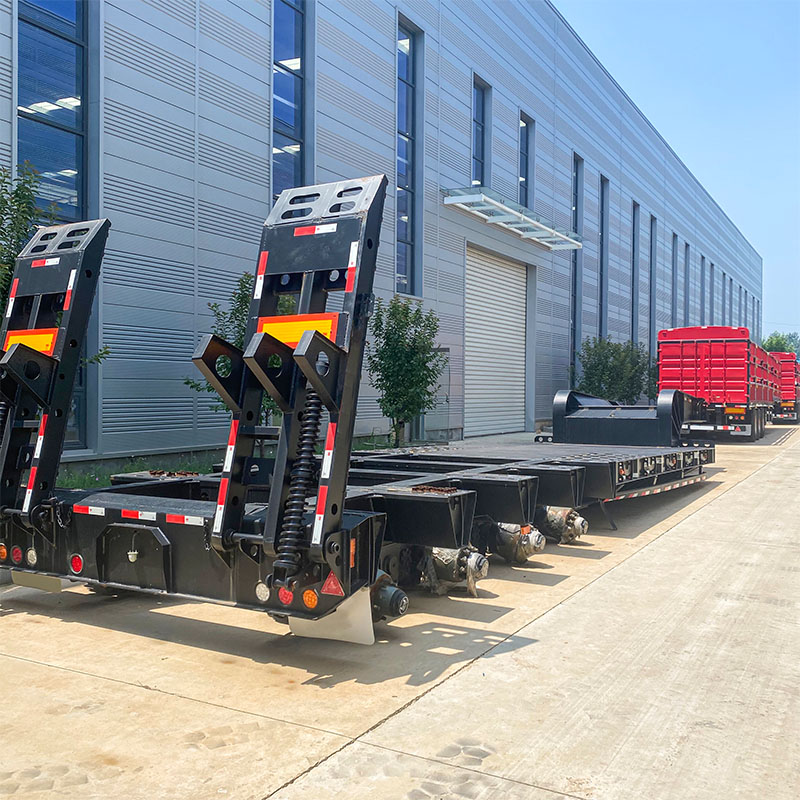
- Loading method. An 80-ton machine will not reverse up a steep ramp safely. Spring-loaded ramps are standard; hydraulic ramps are worth the upgrade for frequent site-to-site work.
- Height budget. With the boom folded, transport height is the main constraint for bridge clearance. Our deck has a minimum height of 850 mm, about 0.3 m lower than common alternatives. This often separates a compliant load from one needing a special permit.
- Very long machines. Long-reach configurations sometimes load front-first over the neck. That is when a detachable gooseneck lowbed trailer earns its price: the neck comes off, the machine drives on over flat ground, and the neck bolts back on. For everything above 100 tons — a 4-axle build stretched further — the same logic continues into the 4 axle 120 ton lowbed trailer.
What Stays Constant on Every 80-Ton Order
Whatever the axle count, the chassis underneath does not change. Main beams are automatic submerged‑arc welded, double‑layer reinforced, built for sustained 80‑ton operation on mine roads with no deformation. Braking: WABCO dual‑circuit + ABS. At this load, braking is a full system, not an individual component.The king pin is a 2″/3.5″ JOST, landing gear is a 28-ton two-speed JOST, and suspension is heavy-duty leaf spring with air or hydraulic options for routes where load cushioning matters. Painting runs through electrophoresis or a polyurethane combination coat, because a trailer that works mine roads dies of rust before it dies of fatigue. Every build in the excavator transport lowbed trailer range from 30 to 150 tons shares these constants — tonnage changes the axle count and beam section, not the discipline.
Five Spec Questions Prior to Quotation
That Tuesday inquiry closed with five questions back to the customer, and the answers produced the final spec. If you are requesting quotes, having these ready shortens the process by days:
- Excavator model and operating weight, plus every attachment travelling with it.
- The route: which roads, and any known bridge or per-axle limits on the corridor.
- Loading method — ramp drive-on, crane load, or front entry with detachable neck.
- Your axle preference, or let us recommend 3 vs 4 lines from the route answer.
- Destination port and terms, so the quote lands FOB or CIF without a second round.
This order quote was for a 4-axle, 20-ton-per-line unit with spring ramps, 850 mm deck, and optional widening package. Try the same breakdown on your next machine — and if any of the five answers surprises you, that is exactly the quote worth getting in writing. Send us the machine details and route, and the axle math comes back with the price.
Need a trailer sized to your excavator, not to a catalog number? Request a quote through our inquiry form or message us on WhatsApp — tell us the machine model, its operating weight, and your route, and we will return the axle calculation alongside the price, or reach us directly.