Nearly every incoming inquiry follows the same pattern: “3 axle 100 ton side tipper semi trailer, CIF Dar es Salaam.” The buyer has already worked out the payload and settled on the axle configuration.But inside that one sentence there are three separate decisions hiding – where the load actually goes when it leaves the trailer, whether the axle math holds on the routes it will run, and what the cargo itself does to the box over five years of loading cycles. Our side tipper semi trailer lineup covers 30 to 100 tons across two, three and four axles, and the specification that finally ships is decided one question at a time.
Decision One: Destination of the Load
The first question we put back to the customer is not about tonnage. It is about the ground beside the trailer. A side tipper is the right choice when your unloading spot sits close to structures that a rear dump trailer cannot safely work around:grain depots with overhead conveying equipment, power station coal yards with height limits, road projects where the load goes straight into a windrow beside the pavement, or mine haul roads where a tipping body raised vertically would be caught by crosswinds on a narrow bench. When the site allows a straight-backed rear tip instead, our 4-axle 100 ton tipper trailer ships in either rear or side dumping configuration on the same chassis – the dump direction is a workshop decision, not a redesign.
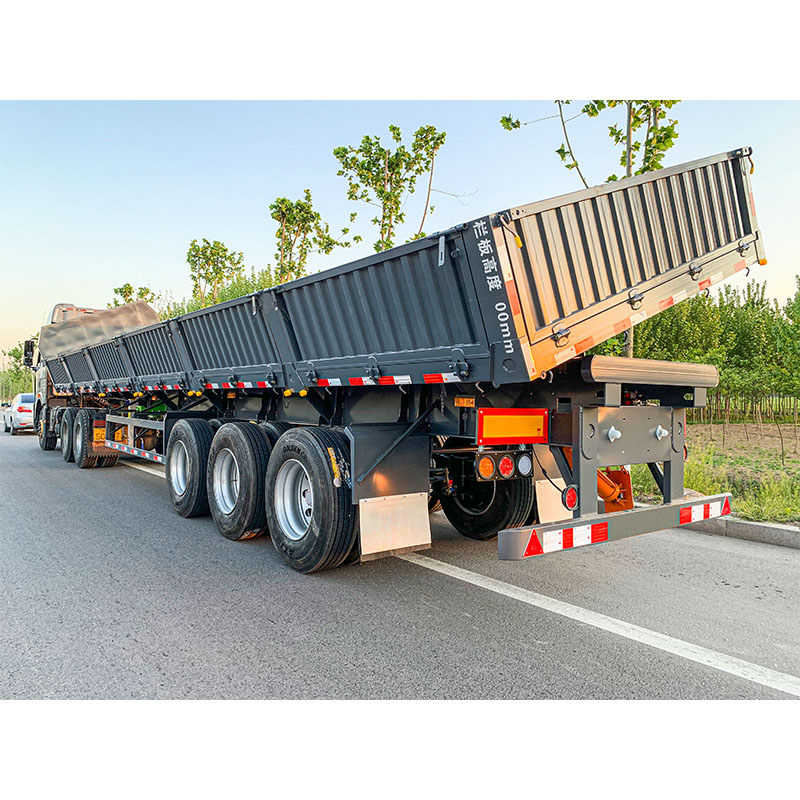
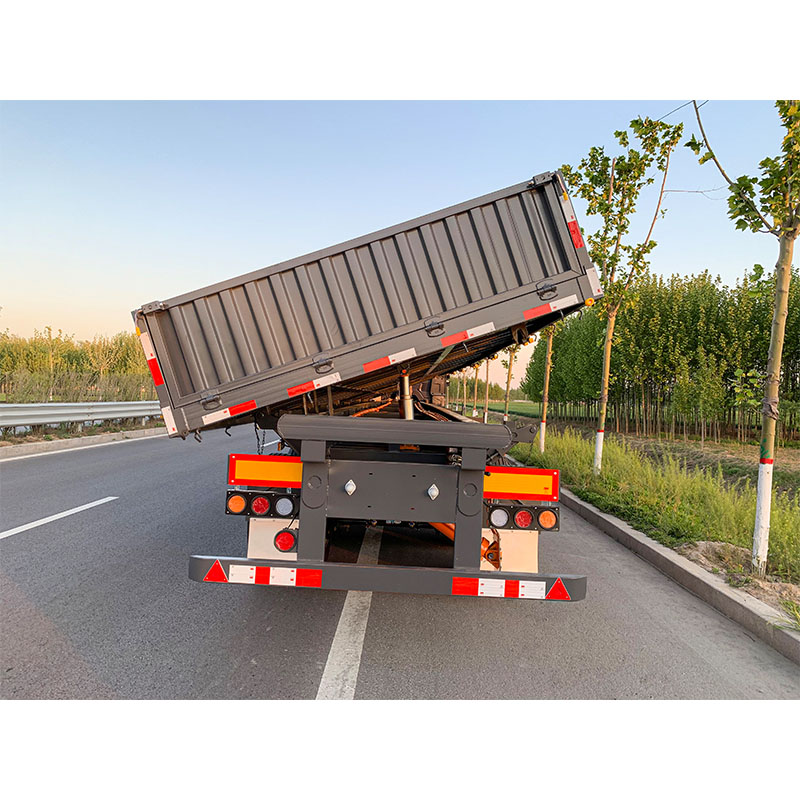
Then comes the angle. Our side tippers work at a 45° to 55° tipping angle, and that number is not decoration – it is the difference between a box that empties clean and one that carries a floor of compacted residue to the next load. Sticky materials like damp coal or clay-bound gravel want the top of that range; free-flowing aggregate is clean at 45°. Cargo boxes are available in two designs: rectangular or U-shaped. The U-shaped model features smooth inner walls that discharge material with minimal leftover residue, making it the top pick for cement and grain haulers. By contrast, the rectangular design delivers greater capacity within the same outer footprint, so it is widely used for sand and gravel transport. Buyers can see both geometries across the 3 axle 60 ton side tipper page, where the standard box measures 11000 × 2500 × 2800 mm.
Decision two: the tonnage math
The second decision is arithmetic, and it follows the same logic we laid out in the 100 ton lowbed buying guide: every FUWA or BPW axle carries 13 or 16 tons, so the rated payload is the axle line total minus the trailer’s own weight. A 2‑axle setup is built for the 30‑ton class; 3 axles cover the 50–60 ton range, while 4 axles deliver the 100‑ton rating. These units use 13‑ton or 16‑ton axles, with 12R22.5 or 11.00R20 tires supplied in sets of 8, 12 or 16 pieces, plus a 28‑ton two‑speed JOST landing gear to support the front end through every loading cycle. The plate thickness climbs with the rating: 5 mm floor plate and 4 mm sidewalls is the working standard for hard rock and ore, with heavier sections available where the loading is brutal.
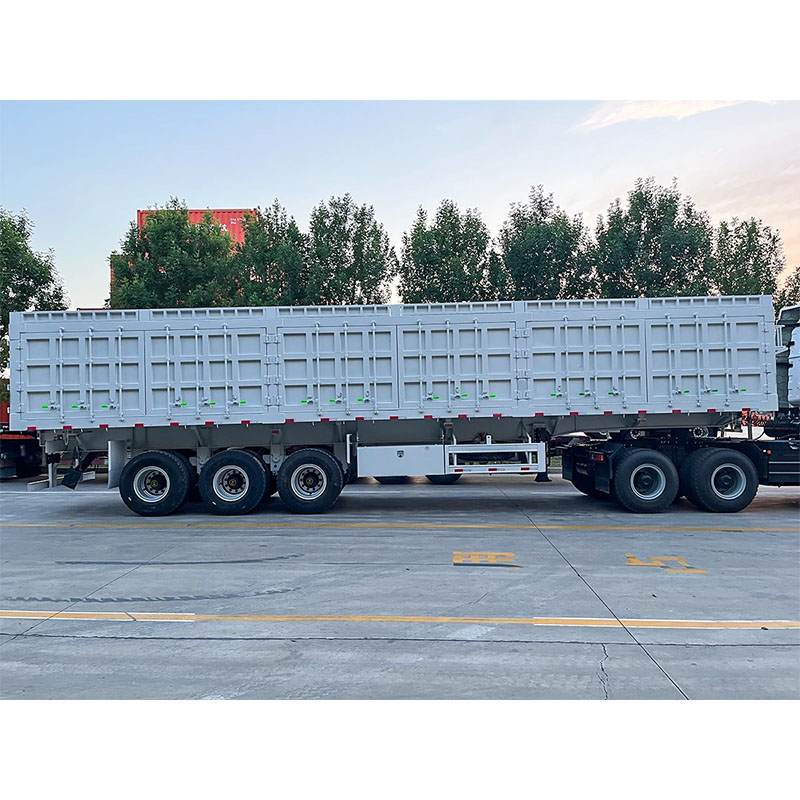
The chassis under all four ratings is deliberately constant: a Q345/T700 high-strength main beam, leaf springs at 90 × 13 or 90 × 16 mm in ten-piece sets, and a choice between mechanical suspension for economy and air suspension where the routes are punishing. Operators who run mixed fleets will recognize the pattern from our 4-axle lowbed lineup – one axle count, several ton ratings, and the difference made up in beam section and plate rather than a new platform.
Decision Three: The Cargo Defines the Box
The last decision is what rides inside. Iron ore and crushed stone grind the floor every cycle, so those builds get wear-resistant steel plate on the box and the rectangular profile that tolerates impact loading. Cement, grain and fertilizer are kinder to the steel but unforgiving on residue, so they take the U-shaped box and, on the cement side, the full 4-axle 50 ton cement side tipper treatment: HYVA cylinders sized to the box length, WABCO dual-line air brakes with ABS, and optional tarp systems for the loads that legislation says must be covered. Sugarcane, silage and wood chips are the light-bulky end of the scale, where the same 30-100 ton platform carries taller walls instead of thicker plate.
What never changes across the lineup
Whatever the ton rating and box shape, every side tipper that leaves the line shares the same bones: Robot-welded Q345 or T700 main beams ensure uniform build quality; chassis rails receive electrophoretic coating to resist corrosion through wet seasons. HYVA hydraulic parts are sized according to box length, paired with a #50 (2 inch) or #90 (3.5 inch) JOST king pin, plus LED lights and reflective tape for safe operation in night loading yards.Internal dimensions and route limits are the same conversation we walk every buyer through in our semi trailer dimensions guide – the 11000 mm box only pays off if the corridors it runs are built for it.
What Really Drives Price Variation
A side tipper semi trailer from this lineup ranges from roughly USD 10,000 to 30,000 at factory price. The bottom of the band is a two-axle, 30-ton rectangular box on mechanical suspension. At the high end sits the four‑axle, 100‑ton configuration, fitted with wear‑resistant steel plate, air suspension, ABS and a full suite of extras. Axle quantity is the largest single factor affecting price, followed by plate thickness, then suspension type. That explains why identical initial enquiries can return three different quotes before those three key decisions are locked in. When you are ready, hand our team the material, the payload, the unloading layout and the route via the inquiry form or WhatsApp, and the 100 ton side tipper spec sheet comes back matched to your run, not averaged across them.
Specifying Side Tippers for Mining & Construction Corridors? Send us the material, target payload, unloading layout and route limits through the contact form or WhatsApp – our team will match the axle count, box profile and tipping angle to your operation and quote factory price with the full spec sheet.