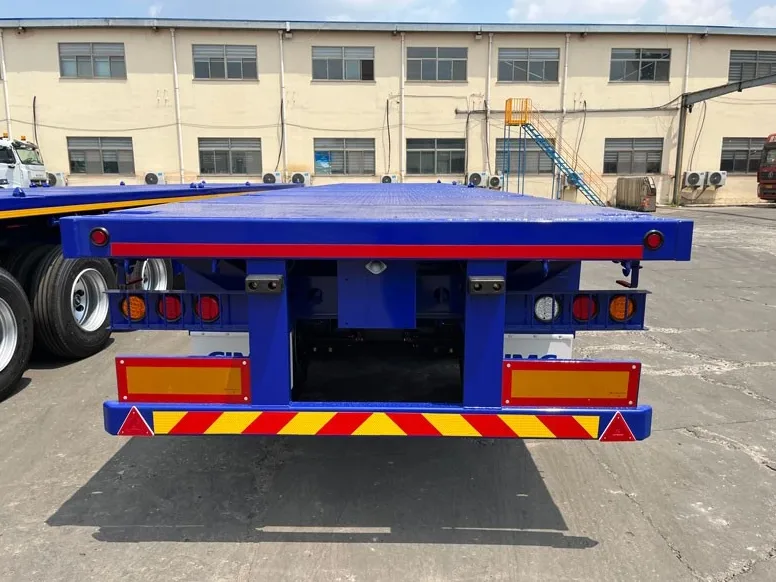
Week after week, our sales inbox receives inquiries for the same equipment under dozens of different names: platform wagon, platform trailer, 40 ft platform semi trailer. To some buyers, the term refers only to a skeletal chassis built to hold a single container. For others, it describes a flatbed deck fitted with twist locks — capable of hauling a container on the outbound trip and steel coils on the return run. This mix-up in terminology masks a substantial market, and its demand trend is heading steadily one way.This is what the 40 foot platform wagon market looks like from where we stand — a factory in Shandong that ships these decks to container corridors on four continents — and how a buyer should read it before wiring a deposit.
What the Container Numbers Say About the 40-Foot Deck
Start with the water, because every platform wagon order starts with a container that came off a ship. Global container volumes closed at 172.1 million TEUs in 2022, 173 million in 2023 and 184.3 million in 2024, and 2025 finished at 192.9 million TEUs, according to Container Trades Statistics. The fastest-growing export lane of 2025 was the Indian Subcontinent and Middle East trade, up 9% year on year, and the biggest beneficiaries were Sub-Saharan Africa and South America — regions that imported more from that lane than in any year before it.
Africa’s own gateway ports tell the same story on dry land. Mombasa moved 2.11 million TEUs in 2025, up 5.5%, and its transit cargo — the boxes heading inland to Uganda, the Democratic Republic of Congo and South Sudan — grew 19.5%. Dar es Salaam lifted total throughput from 23.69 to 27.7 million tonnes, with the second half of the year up 30%, and the Tanzania Ports Authority is targeting 54.59 million tonnes by FY2030/31. Each of those incoming containers requires a deck to move out from the port, and the 40-foot configuration handles the bulk of this volume.
Why 40 Feet Is the Deck the Market Defaults To
The 40-foot unit is not a marketing preference; it is infrastructure. A 40-ft container is 12.192 metres long, and the world’s vessel slots, yard cranes, corridor bridges and truck regulations are all dimensioned around that box. A wagon built to carry one 40-ft container can also carry two 20-ft boxes — which is why the twist-lock layout, not the deck length, is the detail that decides how flexible your wagon really is. Our skeleton trailer guide walks through that arithmetic for pure container work.
Two regional decks break the 40-ft default, and both are exceptions that prove it. West African fleets order the 30-ft deck for domestic gauge roads — we explained why in our 30 ft flatbed piece — while North American carriers standardized on the 48-foot deck for long-haul weight distribution. Between those two extremes, 40 feet is the currency that ports, box lessors and corridor regulators settle in, which is exactly why the market term keeps collapsing onto the same 40-foot wagon. Buyers weighing every deck in between can compare them in the 48 ft breakdown and in the flatbed types overview.
How Much Does a 40ft Platform Wagon Cost Right Now?
Factory pricing for the 40-ft deck family runs from USD 7,000 to 30,000, and the spread is almost entirely explained by axle count and payload rating:
| Build | Axles | Payload | Typical spec | Price band |
|---|---|---|---|---|
| Base 40-ft wagon | 2 × 13t | 20–40t | Mechanical suspension, 8 tyres, 4 twist locks | USD 7,000–12,000 |
| Corridor workhorse | 3 × 13/16t | 40–60t | 8–12 twist locks, FUWA/BPW axles | USD 10,000–18,000 |
| Heavy haul | 4–5 × 16t | 60–80t | 12 twist locks, air suspension option | USD 20,000–30,000 |
Shared by all three variants is this standard package: Q345 or T700 main beams fabricated with automatic submerged‑arc welding, FUWA or BPW axles rated at 13t or 16t apiece, 12R22.5 radial tires, JOST #50 / #90 kingpins paired with 28‑tonne two‑speed landing legs, plus electrophoretic primer beneath the weatherproof topcoat.The full configuration sheet lives on our 20ft/40ft flatbed container trailer page, and the multi-axle variants are laid out on the 20-80 ton container flatbed page.
If you want that sheet priced for your corridor, send the container size, the number carried together, the cargo weight and the destination port through the contact form — our engineers reply within 24 hours with the configuration and the factory price in one document.
Platform Wagon, Skeleton or Flatbed: Match the Deck to the Return Leg
Because the market uses “platform wagon” loosely, the real buying question is about the return leg. If your wagons come back from the inland depot empty, the lighter skeletal chassis moves the same box for less fuel and fewer tyre kilometres — start at the 40ft container chassis page and compare family options on the 20ft/40ft/45ft skeleton lineup.
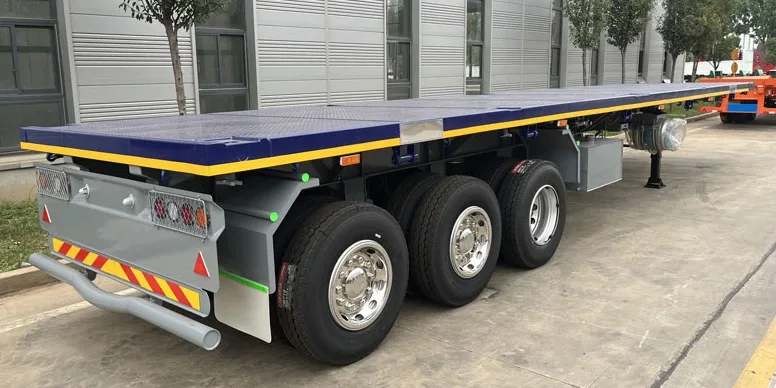
If the return leg carries steel bars, bagged cement or machinery, order the hybrid instead: the twist locks handle the box and the open deck earns its keep on the way back. That machine is our 40ft flatbed trailer with twist locks, and the photo below shows why fleet owners in mixed-cargo corridors converge on it once they price their empty return kilometres.
Buying Into a Rising Market Without Overpaying
Rising container trade pushes up shipment volumes and pricing alike, and buyers who view this platform wagon as a generic commodity end up taking the hit. Confirm these four key points before placing your deposit:
- Quote the exact container mix — 1×40, 2×20, or a 40-ft box with out-of-gauge cargo on top — so the twist-lock layout is engineered into the deck, not guessed at the port.
- Match axle count to the corridor’s legal payload, not to the biggest number on a price list; a 3-axle 60-tonner that runs full every trip beats a 5-axle 80-tonner that runs empty-legged because the permit never clears.
- For multi-trailer programmes, price the knock-down option. Our CKD and SKD cooperation guide shows how local assembly cuts duties and lead time in most African markets.
- Put wear parts in the first order — Spare twist locks, landing legs and brake valves come along affordably with the trailer, yet sourcing these parts separately can hold you up for weeks.
The market signal is easy to read: more boxes are landing on African and Asian corridors every quarter, and the decks that move them are converging on one 40-foot standard. The buyers who win are the ones who order the wagon engineered for their specific corridor — container mix, return leg and all..
How to Read the 40-Foot Platform Wagon Market for Your Shipping Corridor? Send the container mix, cargo weight and destination port — get a factory-direct quote with the twist-lock layout, axle spec and price band in one reply. Request it through the contact form or message us on WhatsApp. VEHICLE MASTER builds 20,000+ trailers a year and answers every spec sheet within 24 hours.