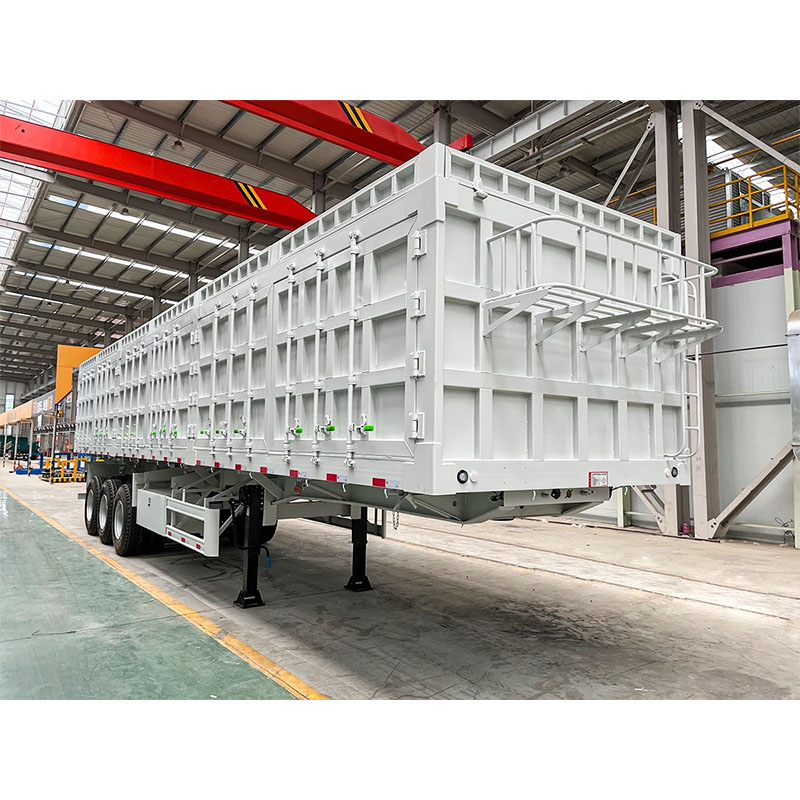
“70-ton tipper trailer for mine transport.” We see this short request hit our quotation desk nearly every week, yet it is the most commonly misinterpreted phrase in the tipper trailer industry. Buyers treat the ton rating like a fixed product. Our quote team treats it as a starting equation — because the same “70 ton” inquiry can end up as three very different trailers depending on the cargo, the road and the discharge setup. This is how that line gets dissected into real steel, the same way our 30–100 ton side dump family gets configured for a live order.
Account No.1: The Axle Math Behind the Sticker Rating
Every ton rating is axle arithmetic first. The axles under our dump boxes are rated at 13 or 16 tons each — Haoyue, FUWA or BPW units. Three axles at 16 tons put 48 rated tons under the frame; four axles put 64. The distance between that arithmetic and the sticker rating is closed by tare weight, road conditions and the short-haul reality of mine work, which is why the same platform stretches across 30, 60, 80 and 100 ton listings.
| Ton rating | Axles (13/16T each) | Tires | Typical assignment |
|---|---|---|---|
| 30–50 ton | 2–3 | 8–12 | Construction supply, city aggregates |
| 60–70 ton | 3 | 12 | Regional coal and ore runs, mixed roads |
| 80 ton | 3–4 | 12–16 | Hard rock, short pit hauls — see the 3 axle 80 ton tipper |
| 100 ton | 4 | 16 | Dedicated pit duty, stable surfaces |
A 70 ton dump trailer almost always resolves to a 3-axle 16-ton build on 12 tires — the same class as our 3 axle 60 ton side tipper — or a light 4-axle version if the return legs run loaded.This is the first point our quotation team clarifies for customers who lead with a tonnage figure: the stated weight refers to the cargo, not the trailer itself.
Account No.2: Which Way the Box Opens
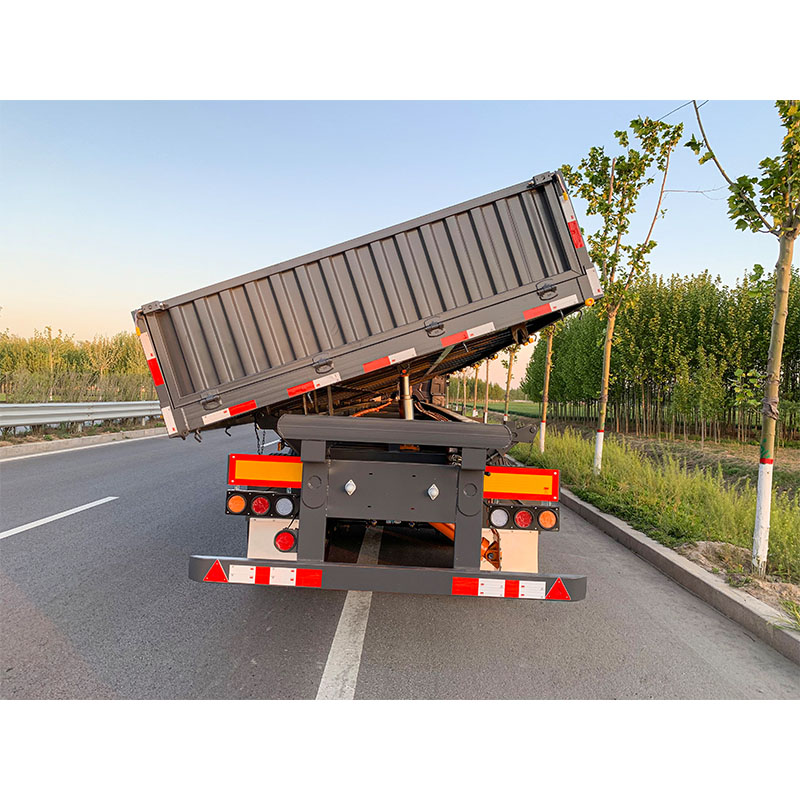
The second decision is not on the inquiry form at all — the discharge setup at the delivery end. Mine sites that unload against stockpile walls or into hoppers need the box tipped sideways; flat yard operations tip rear. On a side dump, HYVA cylinders lift the whole box laterally in a controlled arc, which keeps the tractor stable on uneven ground and dumps the load clear of the wheels. On a rear dump, the cylinder stack drives the box up and back — simpler, lighter, and still the default for long coal corridors.
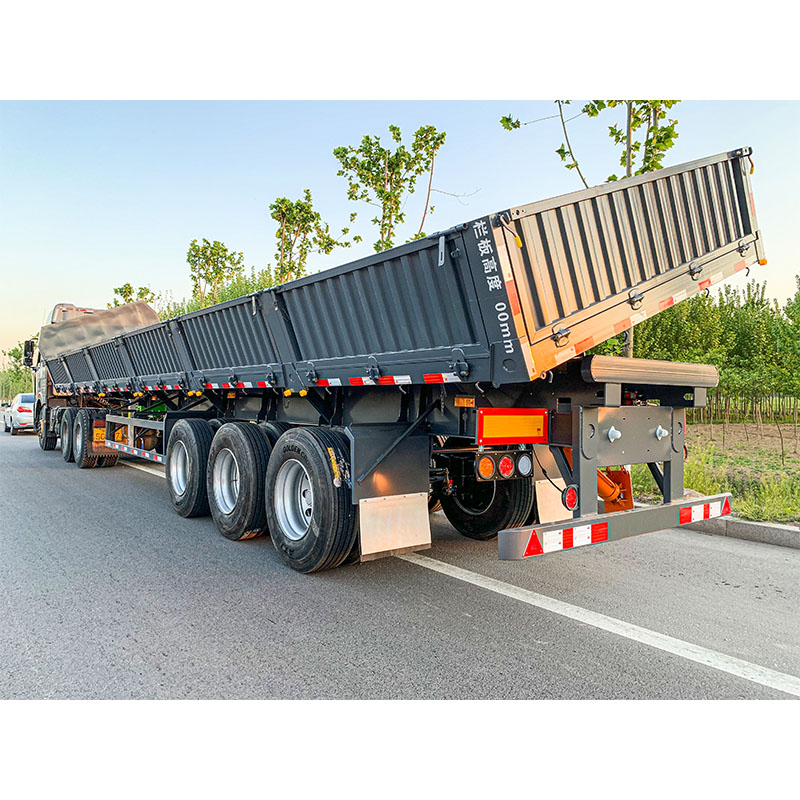
Both versions share the same payload rating, which is why our team typically replies to “70‑ton” enquiries with a follow‑up question: what does your unloading site look like?Buyers who want to see how the full range splits can compare the 100 ton side tipper, the 4 axle 100 ton tipper and the 30–100 ton rear dump coal tipper — one platform, three discharge geometries, as we broke down in our side tipper range walkthrough.
Account No.3: Matching the Tipper Body to Cargo Density
The third account is where identical ton ratings diverge into different plate thicknesses. The standard box on our dump line runs a 5 mm floor and 4 mm sidewalls in wear-resistant steel. That standard assumes ore. Hard rock at ~2.7 t/m³ hits the 70 ton limit at roughly half a full box, so the build focuses on floor thickness and reinforcement ribs. Coal at ~0.9 t/m³ cannot reach 70 tons even with the box heaped — so a coal order keeps the standard plates and spends the weight budget on box length and volume instead.
In other words: the ore version of a 70 ton dump trailer is a thickness decision, the coal version is a volume decision.If you quote these two configurations identically, one specification will be incorrect. For materials with a density falling between the two benchmarks — such as laterite, clinker and wet sand — the tipper body is specified item by item against the payload chart.
What Never Changes: The Running Gear Under the Box
Whatever the ton rating resolves to, the chassis under our dump boxes is constant: a 500 mm main beam in Q345/T700 steel with 16/8/14 mm plates, HYVA cylinders are selected to match the body length, paired with a JOST 28-ton two-speed landing gear, either a #50 (2-inch) or #90 (3.5-inch) king pin, plus 11.00R20 or 12R22.5 tyres fitted across 12 or 16 wheel positions.Suspension is the one open choice — mechanical leaf springs for rough mine roads, airbags where the route includes paved highways — and it is a total-cost decision we have accounted for separately. The cylinder stack deserves the same scrutiny: how dump trailer hydraulics are specified decides whether a 70 ton box lifts in one smooth arc or fights itself for ten years. The axle-count arithmetic itself follows the same logic across our range, as shown in our tri-axle payload calculations.
Five Key Details for an Accurate, Fixed Quotation
By the time a “70 ton dump trailer” inquiry leaves our desk, it has become a specification sheet. To speed up this discussion, include these five points in your initial enquiry: cargo type (and its density if known), one-way haul distance and road conditions, unloading arrangement at the destination, your preferred tipper box length, and order quantity.Those five lines collapse days of back-and-forth into a single firm quote — hand them to our team through the inquiry form and the configuration comes back with the price.
Sourcing a 70‑ton tipper trailer for mining or coal haulage applications? Send your cargo, route and discharge details via our contact page or WhatsApp — our quotation team returns a configured drawing and a firm price, usually within one working day.