Most initial inquiries sound the same: “Cement tanker, 30 tons, your best price?” Our quoting team responds with a follow-up question: what cubic capacity do you require? That is not stalling. With dry bulk cement, the number that decides the tank is volume, and the number that decides the chassis is weight. Density connects the two, and once a buyer sees that link, every other line of the quote — material, compartments, compressor, axles — starts to make sense. This guide walks through the four decisions that set a bulk cement trailer price, in the order we actually discuss them with buyers.
Start from density, not from the price list
Cement settles inside the tanker at approximately 1.2–1.4 tonnes per cubic metre, while lighter powders like fly ash have a much lower density. That means a 30 CBM tank may fill up by volume before reaching its weight limit, or max out on weight before it is full. Everything depends on the material you transport. That is why our 30-ton bulk cement tanker trailer carries a rated load of 30 tons with a customizable tank of 25–70 CBM: the same rated truck serves different powders with different tank sizes.
| Tank volume | Where it fits | Typical job |
|---|---|---|
| 28–34 m³ | ~30 t rated load | Regional delivery, tight plant gates, mixed-brand cement runs |
| 35–45 m³ | 30–55 t class | Main-road distribution between silos and batching plants |
| 50–70 m³ | 60–85 t class, 3–5 axles | Port-to-inland trunking, large mixing stations |
If your powder is light, size the tank for volume first and let the axle count carry the weight; if it is dense, the tonnage rating leads. Send the density figure with your enquiry and we will check the pairing before quoting — see the 30–85 ton dry cement bulker trailer for how the tonnage ladder stretches across 2/3/4/5-axle chassis.
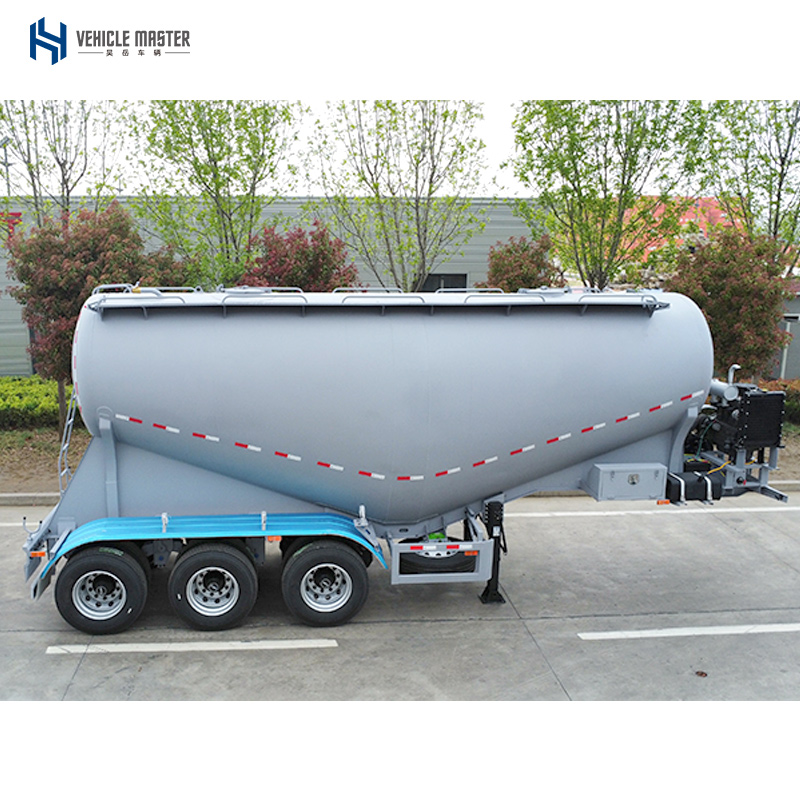
Tank Material Options: Carbon Steel, Aluminium, Stainless Steel
Three materials share the catalogue, and the right pick is an economics answer, not a preference. Carbon steel is the baseline: tough, repairable anywhere, and priced for fleets that want the lowest entry cost. The tank shell is made 4–5 mm thick, with 5–6 mm thick dished heads. This build stands up to rough operation at mine sites and abrasive mineral powders.Aluminum alloy trades wall thickness for weight — a lighter tank legally hauls more on the same axles and burns less fuel on every trip, which is why high-volume lanes order the 70 m³ aluminum 2-axle tanker trailer for cement. Stainless steel earns its premium where the powder is food-grade or corrosive: flour, starch, milk powder, chemical additives. The 70 m³ stainless 4-axle tanker covers that end of the market, and food-grade internal linings can be specified on other tanks as well. The 2/3/4-axle dry bulk cement trailer page lists the material options side by side.
Unsure which side of the trade-off your route lands on? Send us the powder, the distance and the legal axle limit, and we will price both materials.
Discharge gear: what actually empties the tank
A bulk cement trailer earns its keep at the silo, so the unloading package deserves more attention than it usually gets. The standard setup combines a Weichai 4102 diesel engine and a Bohai air compressor rated at 12 cubic metres per minute. The compressor aerates the powder across the cone’s internal fluidising bed, and pressure inside the tank forces the material along the discharge pipe into the storage silo. Discharge speed on the 30-ton model runs 1.2–2.8 CBM/min — over a 30-ton load, the gap between those figures is real waiting time at a busy plant gate.
Two layout details worth specifying. First, compressor placement: the diesel-compressor set mounts at the front near the kingpin or on the rear platform, and each layout changes weight distribution, service access and how the unit handles dust. Second, power source: the 3-axle bulk cement tanker trailer can be configured with diesel or electric drive, which matters where sites run on grid power or emission rules restrict idling diesel engines. Both arrangements are shown below.
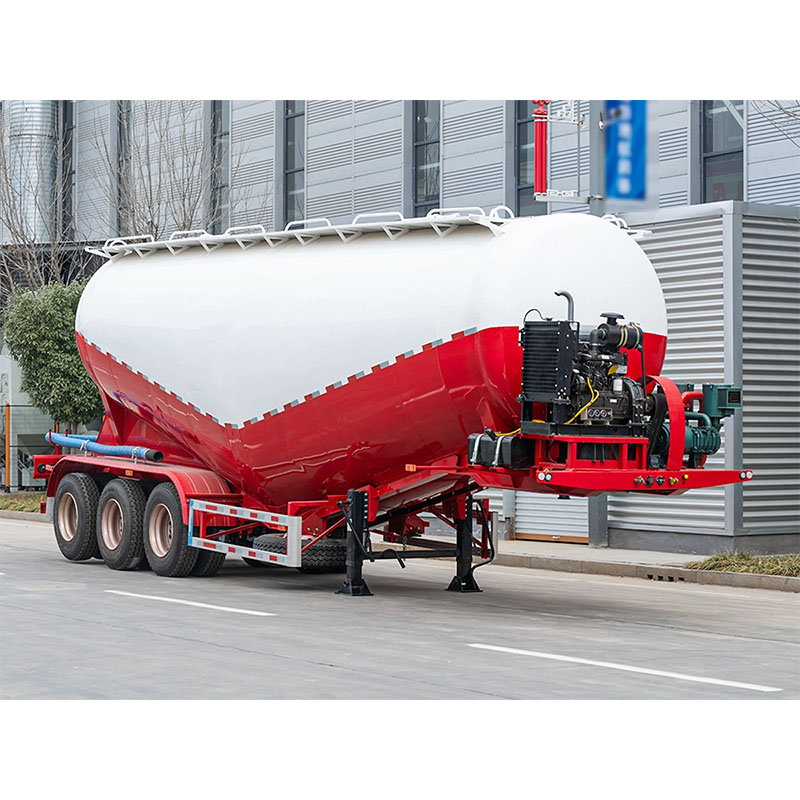
Tank design directly affects this part of the discharge system. V-shaped tanks funnel material toward one discharge outlet and work best for single-powder hauls. W-shaped tanks have two separate compartments and usually offer larger capacity, so you can deliver two cement types or split cargo for different customers in a single trip.The W-shape 2-compartment bulk cement tanker trailer shows that layout, and our earlier guide to powder tanker tank shapes and compressor choices explains the fluidization differences in depth. Compartment count runs 1–3 across the family.
Maintenance for Stable Discharge Rate
Discharge speed is a maintenance number as much as a specification number. When a tank that used to empty at 2.5 CBM/min slows to a crawl, the cause is almost always one of three things. First, the fluidizing bed: the airslide fabric inside every cone can get blocked by fine cement dust or rip after heavy-duty use. When this happens, the discharge air just blows through narrow channels instead of fluidising the powder, leaving material stuck inside the cone. Second, air leaks: a worn manhole gasket or a loose quick-fit coupling bleeds off the pressure the tank needs to push powder up the delivery line — a gauge that reads 0.15 MPa where the job used to hold 0.2 is describing a leak, not a weak compressor. Third, compacted residue: cement left sitting in the tank overnight, and worse over a humid weekend at a sea-port yard, absorbs moisture and sets into lumps that no compressor will move.
The routine that prevents all three is short. Blow the tank down with compressed air after every discharge until the sight glass runs clear, crack the manhole covers so the interior dries, and drain the compressor’s air receiver at the end of each shift. Stick to hour-based compressor servicing rather than seasonal schedules. The Weichai 4102 unit is low-cost to service, but costly to rebuild. For fleets with frequent runs, inspect the fluidising fabric every month, and keep two spare fabric sheets plus a manhole gasket set on hand. We can pack these items into a spare parts kit for you if you request it when placing your order.Once a year, walk the weld seams with a work light and check the internal walls for abrasion, especially on mine-run trailers hauling abrasive blends. The paint system on the 3-axle bulk cement tanker trailer is an electrophoresis primer with a topcoat chosen to resist powder scouring, but a stone chip left unpainted through a wet season grows into a patch-repair job. And because the chassis carries the tank, keep the running gear honest too — the cost trade-offs between mechanical and air suspension include what each design spends on maintenance over five years, which matters when the trailer lives on unpaved plant roads.
Axles and running gear: your route writes this line
Axle count is decided less by the tank than by the road. Every axle in the family carries 13 or 16 tons on FUWA or BPW axles, so a 3-axle machine is legal on routes that cap a 4-axle combination, while heavy 60–85 ton jobs move to the 4- and 5-axle dry bulkers. Suspension is available as mechanical leaf spring or air type. Tandem leaf spring assemblies equipped with high-tensile tie rods preserve axle alignment over corrugated mine tracks and avoid tyre scuffing which reduces operational profits. Air suspension provides shock absorption for the welded tank during extended highway transit.Braking is a WABCO air system with ABS on the bulker line, tires are 12R22.5 at four per axle, and every trailer lands with a JOST 2″/3.5″ kingpin and 28-ton two-speed landing gear. Overall envelope runs 11,000–13,000 mm long, 2,500 mm wide and 3,800–4,000 mm high — check that height against any silo gantries or container transfers on your route.
Factors That Shape Your Final Quotation
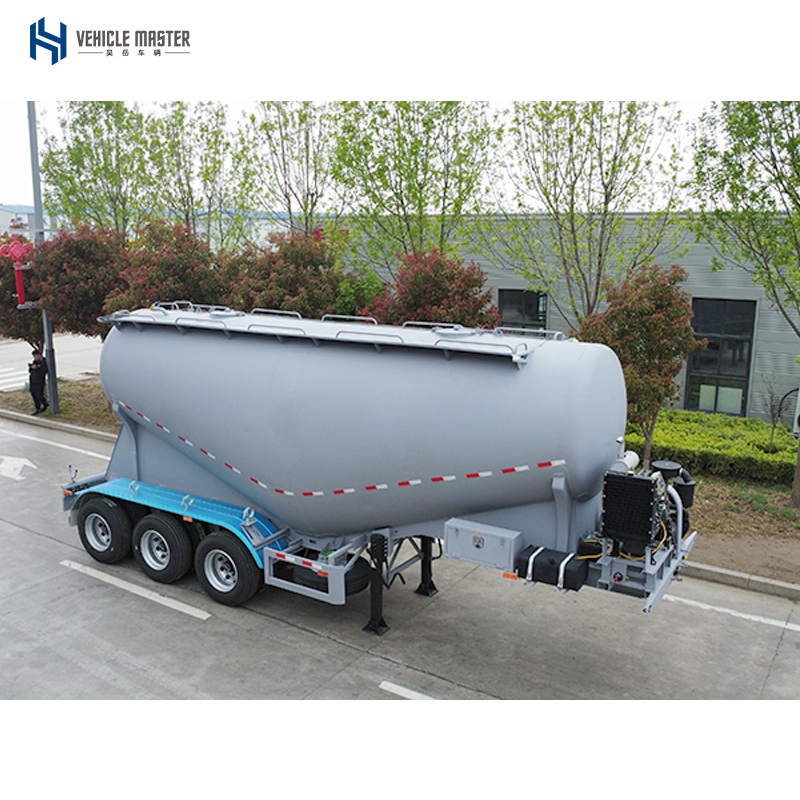
Factory pricing across the cement family spans roughly USD 10,000–45,000: the 30-ton model lists at 11,000–35,000, the pneumatic 30–70 CBM trailer at 15,000–45,000, and the aluminum 70 m³ tank at 10,000–40,000.The price difference hinges on five adjustable factors: tank material, tank capacity, number of compartments, discharge configuration (compressor output, diesel or electric drive), and running gear choices like air suspension or an extra fourth axle.Custom work sits on top: the custom cement bulk tanker page covers special volumes, compartment layouts and destination-market modifications, and explosion-proof or food-grade builds are quoted case by case. For the mainstream trunking spec, most fleets land on the 30–70 m³ pneumatic bulk cement trailer or the 30–70 m³ bulk cement tanker with carbon steel and a three-axle chassis.
The six details that get you a same-week quote
Our quotation team turns enquiries around fastest when the first message carries six things: the cargo (powder type and density), the dimensions you need, the loaded weight, the loading method at your pickup point, the quantity, and the destination port or border post.Share your target silo discharge rate and any certification paperwork needed for your market, and we will have all the details to prepare an accurate quote with no guesswork.Hand the spec to our team via the inquiry form and we will come back with a configuration, not just a price.
Planning a bulk cement trailer order? Send your route, powder and axle limit to the Vehicle Master quotation desk — and we will match the tank, material and discharge kit to the job before quoting.