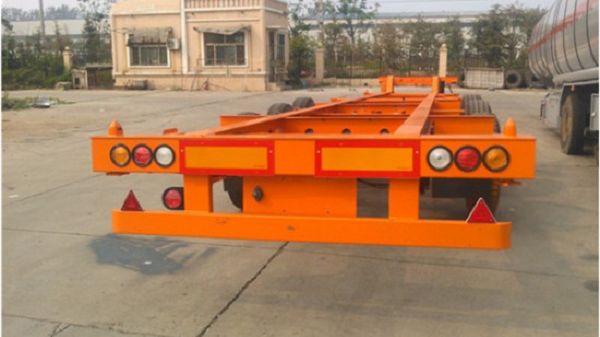
Nearly every week, we receive quote requests opening with the phrase: “I need a price for a container lorry.” This single term often reveals the buyer’s region before we even see their signature. In Kenya, Nigeria, Ghana, Uganda and much of the Commonwealth, a container lorry means the full rig — the tractor truck plus the skeletal trailer behind it. North American fleets order the same hardware but call it a container chassis. Nine times out of ten, the tractor is already in the buyer’s yard. What they need from us is the chassis that turns that tractor into a working container lorry — and the spec on that chassis is what this article walks through.
What Your Lorry Order Really Includes
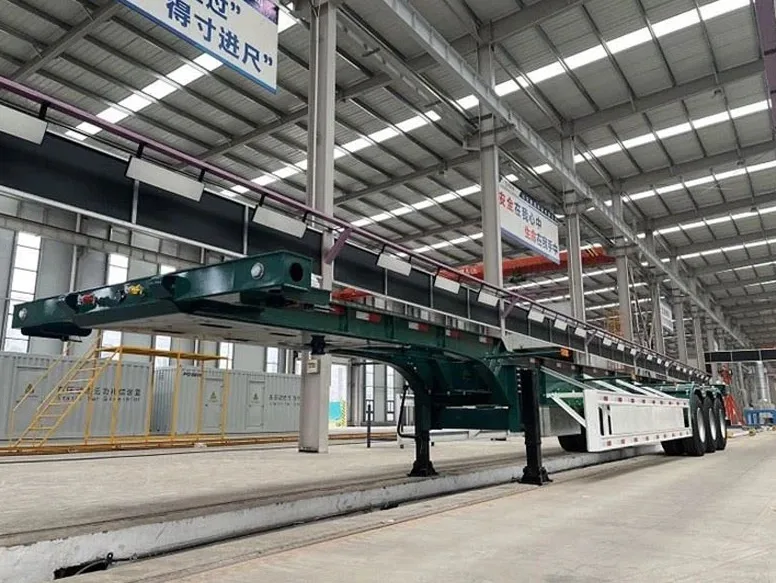
The container lorry side of our lineup covers skeletal trailers from 20 ft to 45 ft, in two, three or four axle configurations, with rated loads from 20 to 60 tons. Every order still resolves into the same three decisions: which boxes it will carry and how many per run, what kind of run it will do day after day, and which underspec’d components will still be on the trailer five years from now. Get those right and the quote writes itself; get them wrong and the fleet pays for it in tire bills and downtime.
We published a full size-matching guide comparing 20 ft, 40 ft and 45 ft skeleton trailers earlier, so this piece stays on the decisions that come after the box size.
Decision 1: The Twist Lock Layout
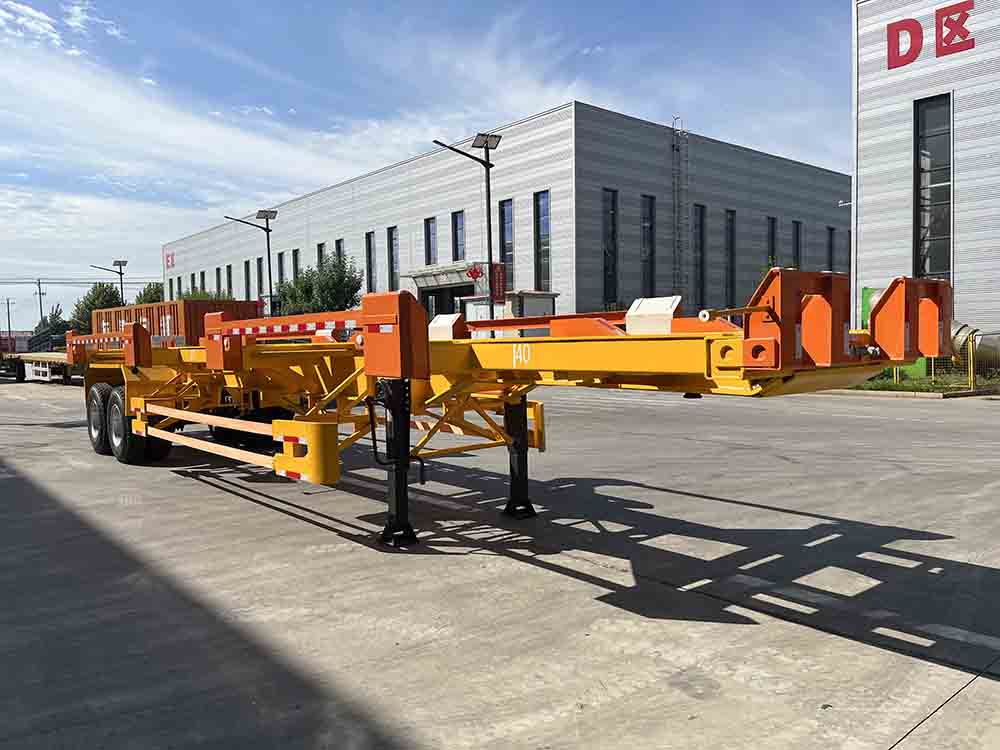
A container trailer makes its revenue thanks to twist locks. Our standard 40ft skeleton trailer measures 12,500 × 2,500 × 1,600 mm, fitted with either eight or twelve twist lock sets, based on the number of containers the fleet needs to haul per trip. A single 40 footer needs the basic eight; running two 20 ft boxes per run — the bread-and-butter configuration for regional distributors — needs the twelve-set layout with locks positioned for both 20 ft footprints. Fleets that mix box sizes across the week order the extendable structure instead, one chassis that adjusts between 20, 40 and 45 ft positions so a depot is never stuck with the wrong trailer for the load on the dock.
Lock count is cheap to specify correctly at order time and expensive to retrofit in the field. When you send an inquiry, tell us the container positions you run — not just the biggest box, but the combinations. Our engineering team confirms the exact lock layout against the catalogue configuration before anything goes to production, at no design fee.
Decision 2: What the Run Looks Like
We configure this identical skeleton chassis in four distinct setups to suit different operating routes. This is why ordering a container trailer is far more than buying hardware — it becomes a route-specific solution.
| The run | Typical spec | Why |
|---|---|---|
| Port transfer — boxes shuffled between ports and yards | 2 axle, posts and rails option, lighter tare | Short cycles reward maneuverability and low running weight, not payload ceiling |
| Long-distance corridor — containers between countries and cities | 3 axle, reinforced mechanical suspension, 13/16 t FUWA or BPW axles | Stability and axle durability under continuous full loads; the configuration most Kenya-market lorry orders settle on |
| Logistics park transfer — fast moves inside a compound | Optional steering axle | Tighter turning radius where space, not distance, is the constraint |
| Mineral and tank containers — bulk runs, heavier boxes | 4 axle, rated load pushed toward 60 t | Dense cargo needs the extra axle line before it needs a bigger frame |
The four-run framework is not marketing shorthand — it is how our Nigeria-spec chassis page is organized, because that is how fleet managers describe their own operations when they write to us. Suspension follows the same logic: standard leaf springs stay economical, durable and low-maintenance on rough corridors, while air suspension is ordered for sensitive or high-value runs where shock absorption matters more than simplicity.
Decision 3: The Overlooked Components
The third decision is the one most buyers skip — and it is the one that decides whether the lorry is still earning in year five. A few items on our skeletal builds exist precisely because container runs punish the underspec’d components:
- Braking: dual-circuit air brakes with WABCO ABS as standard, EBS available — because a loaded lorry on a wet port ramp is the worst place to discover a brake spec was trimmed.
- Corrosion protection: electrophoretic coating with polyurethane composite paint over it. The standard process is sandblast and spray; e-coat is the upgrade worth taking for coastal and humid-corridor fleets.
- Welding: main beam and frame welded by automated robotic systems with laser positioning — consistency a manual crew cannot hold across a full production run.
- Anti-abrasion suspension: Suspension geometry holds tires aligned under load, minimizing irregular wear that inflates tire expenditure for container trailers
- Landing gear: JOST two-speed landing gear (28-ton capacity, -30°C ~ 120°C working range), supporting the full container weight for each drop-and-pick cycle.
- Electrics: 24V moisture-proof LED lighting with copper-sealed connectors, so a rainy-season corridor does not become an electrical fault hunt.
The main beam under all of it is Q345B/T700 high-strength I-beam steel. That spec is common across the industry on paper; the robotic weld and coating process above are what make it survive the difference between a spec sheet and a decade of loaded runs.
The Figures Behind Your Quotation
For the workhorse configuration — the 40 ft three-axle skeleton most lorry orders settle on — the reference numbers are a 12,500 × 2,500 × 1,600 mm frame, 40,000 kg rated load against roughly 6,000 kg tare, twelve 12R22.5 tires with two spares, a JOST #50 (2″) or #90 (3.5″) king pin, and ABS braking standard. Pricing varies depending on axle quantity, twist lock arrangement, suspension type and selected extras. This explains why two seemingly identical trailer quotations can differ greatly. You can view available configurations and price ranges on our 40 ft container trailer pricing page.
To get a usable quotation in one round, include the six things our team asks every fleet for: the cargo, the container dimensions, the loaded weight, the loading method, the quantity, and the destination port. A quote built on those six answers covers delivery terms — FOB, CFR, CIF or EXW — the documents for your configuration, a one-year warranty, and lifetime original spare parts supply. If you are weighing a skeletal lorry against a flatbed for mixed cargo, our earlier guides on how Africa’s port corridors changed what fleets order and on flatbed trailer types from standard decks to double drops cover the other side of that decision.
Hand your run profile — boxes per trip, corridor, loaded weight — to our team through the inquiry form, and the configuration comes back with the lock layout and axle count mapped to it.
Sourcing a container trailer for your upcoming fleet order? Tell us the container sizes you run, the route and the loaded weight — Vehicle Master’s team will map it to the right skeletal chassis configuration and send a quotation. Reach us via the inquiry form or WhatsApp.