Nearly every incoming enquiry follows the same wording: “4‑axle lowbed semi trailer with sidewalls, 80 tonne, CIF Mombasa.” On the surface, it seems contradictory — a low deck designed to transport excavators, fitted with sidewalls made to contain bagged cement. It is not. That single sentence describes a fleet owner who refuses to drive home empty, and the 4 axle lowbed platform is the only chassis class where the two cargo businesses coexist without either one compromising the other.
The backhaul problem the walls solve
A dedicated machine-hauling lowbed earns money in one direction. The loader or excavator rides to the site, the trailer turns around, and the deck comes home bare – burning the same fuel, wearing the same 16 tires, generating nothing. On East and West African project corridors a contractor can cover the outbound leg with machine moves yet still lose the month to empty return legs. Adding sidewall panels to the deck converts that dead leg into revenue: the same trailer that delivered the excavator leaves the site carrying bagged cement, sand in tonne sacks, steel pipe, or fencing posts. Operators running this setup tell us the sidewalls pay for themselves within a single season. The panel add-on costs only a small portion of the trailer chassis, yet the backhauls it makes available deliver almost entirely profit.
The combination only makes sense above roughly 60 tons of axle capacity, which is why we build it on four axles rather than stretching a lighter chassis. The same logic runs through our 30 to 150 ton lowbed family: two and three axle decks already spend their axle allowance on the machine outbound, leaving no margin for bulk weight on the return.
What the sidewall actually is
The wall system on these builds is not welded superstructure. It is a set of removable panels seated in sockets along the deck edge – drop them in and the lowbed holds loose and bagged cargo; pull them and the deck reverts to a clean machinery platform with lashing points exposed. Three configurations cover nearly every order:
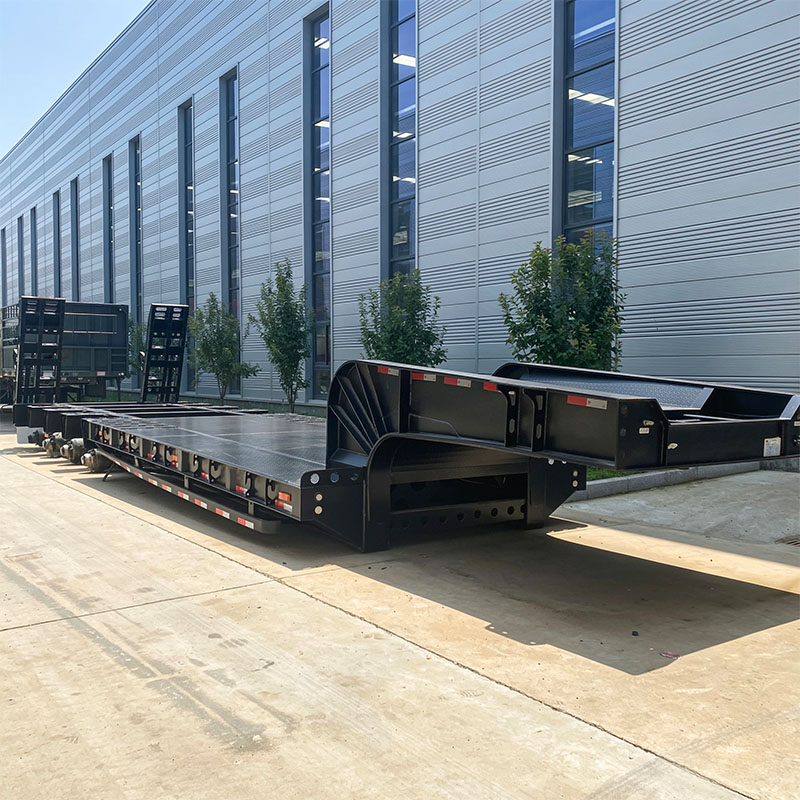
- 600 mm drop sides – gravel, sand and rubble containment on short hauls; quickest to remove.
- 800–1200 mm intermediate sidewalls – the dual-cargo workhorse: bagged cement, fertilizer, pallets, timber, pipe.
- 1500 to 1700 mm full-height fence -Light bulky return loads: empty drums, plastics, fencing, formwork.
Wall plate runs 1.5 to 3 mm high-strength steel on a 42-rib skeleton, sized to the cargo you actually carry home – the taller the wall, the lighter the plate, because nobody straps ore into a 1700 mm fence. Buyers who need weather cover for the return leg can swap the solid panel concept for a curtain or solid side wall semi trailer from the same factory floor; the wall decision framework is one we walk through in detail on the side wall trailer lineup page.
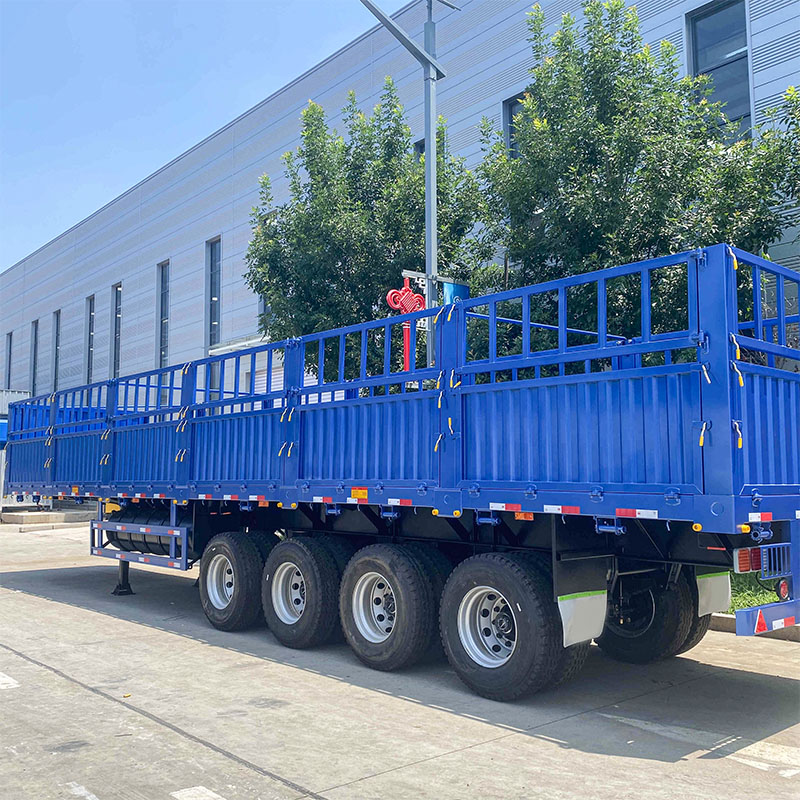
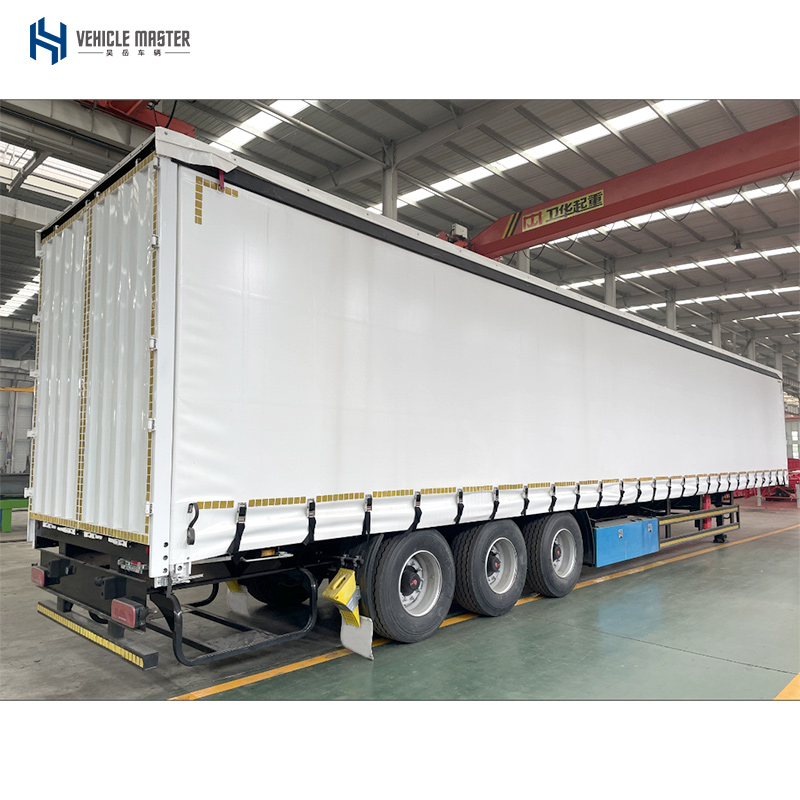
he four‑axle chassis remains unchanged
Walls or no walls, the deck underneath is the standard 4 axle 80 ton lowbed our excavator customers already run: FUWA or BPW axles at 13 or 16 tons each, 16 tires on 12R22.5 wheels, a working deck around 13000 × 3000 mm with a loading height from roughly 850 mm, and a Q345B/T700 main beam joined by submerged arc welding. We break down the full reasoning behind how a single axle configuration can support multiple tonnage ratings in our article covering the 4‑axle lowbed range. To put it briefly: the load rating is determined by the beam profile and steel plate thickness, not the number of axles. That means the 80‑tonne, 100‑tonne and 120‑tonne versions of this trailer differ mostly in the steel structure beneath the deck.
The sidewall option costs the chassis about 800 to 1200 kg of tare weight – real money on a two-axle trailer, noise on four axles rated for 80-plus tons. That is the quiet reason the with-sidewall inquiry is always a four-axle inquiry: the wall budget fits inside the axle margin without touching the machine payload. Landing gear is a 28-ton two-speed JOST set, the king pin a #50 (2″) or #90 (3.5″) unit, and the underside carries the electrophoretic primer and polyurethane top coat that keeps these decks serviceable through wet-season corridor work.
Ladder or ramp versions are often requested in the same enquiry
Buyers asking for a 4 axle lowbed semi trailer with sidewall almost always add one more clause: an automatic ladder, or loading ramps, or both. The pattern is self-loading contractors – the walls manage the return cargo, the ladder manages the machines when no loading bay exists. Spring‑assisted ladders are manually deployed within minutes and carry the lowest cost. Hydraulic ladders, by contrast, lower with the press of a button and justify their higher price when the trailer is loaded multiple times each day. Ramps follow the same split. Where the machine fleet includes tracked equipment that must drive on from the ground, or where the front of the deck needs to open entirely, the order moves to a 4 axle detachable gooseneck lowbed and the sidewall panels are retained on the main deck behind it. The tonnage-first version of this decision process – axle math before accessories – is the one we detail in the 100 ton lowbed buying guide.
What to put in the inquiry
A quotation for this configuration comes back accurate when the inquiry carries five items:
- The outbound cargo – machine weight and dimensions, which set the deck length and ton rating.
- The backhaul cargo – material and how it is packed, which sets the wall height bracket and plate.
- Wall behavior – removable fence panels, fixed solid walls, or curtain, and whether they must survive forklift contact.
- Loading method – automatic ladders, spring‑assisted ladders, ramps or goosenecks — selected based on whether the machinery can self‑load on site.
- The route – bridge heights and axle load limits on the corridors, which can force a lower deck or a different ton split.
Send those five lines through the inquiry form and the spec sheet that returns matches one deck to both cargo businesses – not a compromise between them.
Selecting a Dual-Cargo Lowbed for Site Transport Corridors? Send the outbound machine, the return cargo, wall height and loading method through the contact form or WhatsApp – our team quotes the 4 axle lowbed semi trailer with sidewall configuration against your actual route, with the full chassis and wall spec sheet attached.