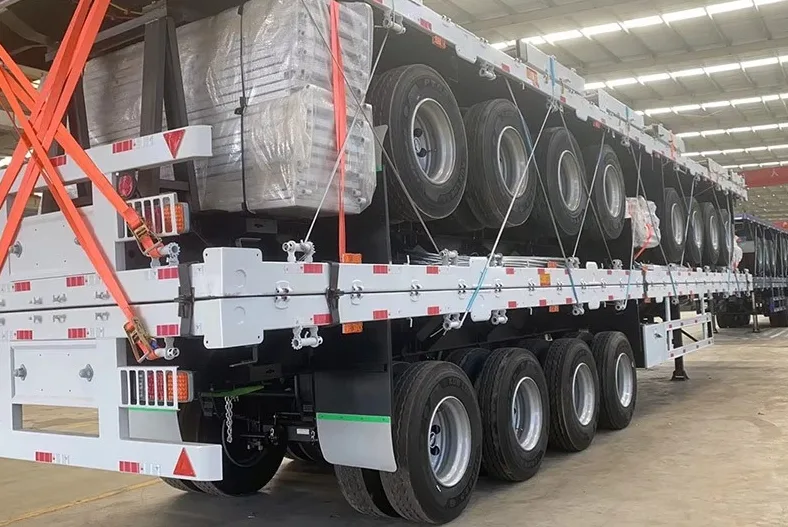
Among all the trailer lengths we quote, one specification stands out repeatedly: 48 feet. Sitting between nimble 20‑foot units for port shuttling and 53‑foot models that hit maximum legal length limits, the 48 ft flatbed trailer has quietly become the default deck for long-haul work — not just in North America, where the length was standardized, but on East African corridors and Middle East trunk routes where fleets now order it by the batch. This article unpacks why: the dimensions package, the weight math, and the spread axle setup that serious buyers pay extra for.
The Dimensions Package: 48 Feet, 102 Inches, 13’6″
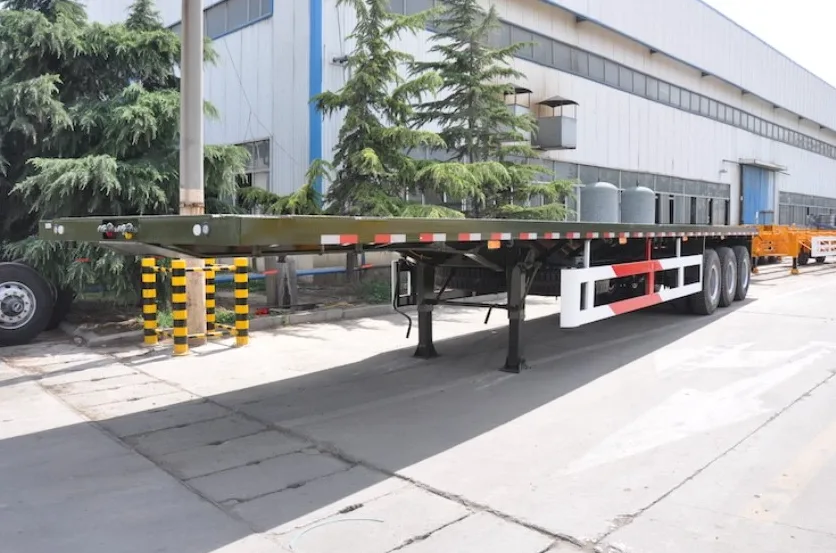
The 48 footer’s dimensions are not arbitrary — every number is a regulatory ceiling. The deck runs 48 feet, the width 102 inches — exactly 8.5 feet, the maximum legal width in North American freight before permits enter the picture. Overall height caps at 13 feet 6 inches, the bridge-clearance budget on interstate highways, with the load deck sitting roughly 5 feet off the ground so cargo height can use the rest.
The five-foot deck height also does quiet work at the dock: it puts the load surface close to standard ramp heights, so forklifts load level instead of climbing and machinery rolls up a short incline instead of a steep one. That regulatory inheritance travels well. Buyers in Mombasa, Lagos and similar markets get a deck width compliant with maximum legal load widths across most regions. Its length allows easy maneuvering inside terminal yards, and its height is pre‑engineered to work with existing fixed site infrastructure. For fleets that also run other trailer sizes from 20 to 60 feet, the 48 footer slots in as the long-haul workhorse without any route re-survey.
The Weight Breakdown for 48,000 Lbs
On paper the capacity conversation is simple: tare weight runs 10,000–14,000 pounds depending on flooring — aluminum keeps it at the low end, steel at the high — and payload capacity reaches 50,000 pounds, with maximum weight capacity quoted at 48,000 lbs for the standard tandem build. The real conversation is about where that weight sits.
A tandem axle group concentrates the rear load across two axles spaced inches apart, which keeps the trailer compact and cheaper but makes every bridge and weighbridge see one heavy cluster. The flooring choice sets the baseline first: aluminum decking trims roughly 4,000 pounds off the tare weight, which returns as payload on every trip for fuel-sensitive long-haul operators; steel decking gives that weight back but shrugs off forklift circuits and machinery point loads that would gouge an aluminum deck. Fleets transporting dense steel and machinery components usually accept this trade‑off, while container and general cargo carriers rarely will.Adding axles — our flatbed line runs 2, 3 and 4 axle builds from 20 to 80 tons — spreads the same payload across more contact points. It is the same arithmetic our fleet customers apply when they re-order the 30 ft flatbed trailer for shorter runs: match the axle count to the route, not to the cargo alone.
Spread Axle: The Setup Buyers Pay Extra For
Ask for a “48 spread axle flatbed” and any manufacturer knows exactly what you mean: instead of a tight tandem pair, the two rear axles are separated to roughly ten feet apart. In North American weight law each separated axle is weighed as its own unit, which raises the legal payload the same trailer can carry — that is why spread axle commands a premium there. On African trunk routes the logic differs but the destination is the same: two distant axles halve the concentrated load each bridge joint and pavement section absorbs, and they sharpen traction on unpaved gradients.
The trade-offs are real. A spread axle creates a wider turning radius. Its front tires scrub in tight terminal turns and place greater stress on suspension bushings compared to a tandem axle setup. That is precisely why we match this configuration with our anti‑scrub suspension system, which maintains proper wheel alignment even under full load.There is a third path worth quoting: a 3-axle 48 footer on a leaf-spring bogie splits the difference, adding one more axle of legal load capacity without the full spread-axle turning penalty — the common spec where weighbridge limits matter more than yard maneuvering. Buyers who run mostly straight highway mileage upgrade without hesitation; fleets that spend their day inside logistics parks more often stay tandem and bank the saving.
Cargo for the 48-Foot Trailer
The length is a container story first. Forty-eight feet swallows one 40 ft or 45 ft box with room to spare, or two 20 footers nose to tail — order the twist lock layout to match and the deck switches between box and breakbulk in one stop. Beyond containers: steel pipe and rebar bundles use the full straight deck, timber and logs ride against removable side pillars, and machinery loads strap down against the side rails.
That flexibility is why the 48 footer outsells the longer decks in our full 20–60 ft flatbed range in export orders — 50 and 53 footers buy extra length that most corridors cannot legally use, while 48 feet stays inside nearly every envelope. For how the 48 footer sits among all the other flatbed deck types, our comparison guide walks the full ladder from standard decks to double drops. A detailed 48ft flatbed trailer spec sheet is available for each axle configuration.
The Chassis Constants
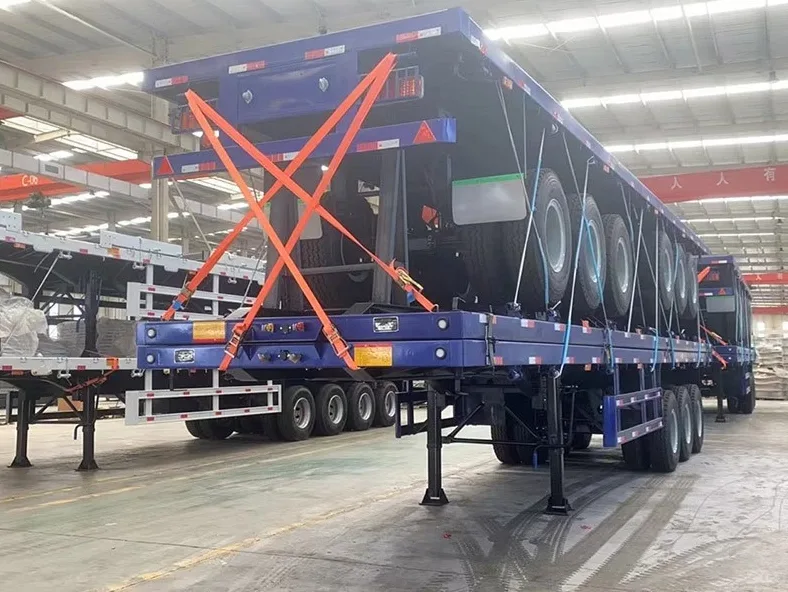
Whatever the axle layout, the engineering under a 48 footer stays constant across the range. The main beams are constructed from Q345B / T700 high‑strength steel, fully welded by robotic welding systems under regulated welding inspection. Each weld joint receives 30 minutes more welding time than the industry standard. After all, a 50,000 lb payload, cycled year after year on rough roads, will expose any corner cut.The king pin and two-speed landing gear come from JOST or equivalent, rated from -30°C to 120°C so the same chassis serves Canadian winters and Gulf summers. Suspension follows the same route-first logic: mechanical leaf springs for rough gravel duty where simplicity survives anything, air ride for paved corridors where ride quality protects the cargo — both available on the same chassis. Electrophoresis primer seals the frame inside and out — the process that keeps corrosion protection effective up to nine years — and moisture-proof LED lighting keeps the deck legal through night corridor runs.
Finalize Your Specs Before Requesting a Quote
A precise 48 ft quotation needs six answers: the cargo, its dimensions, loaded weight, loading method, quantity and destination — plus one decision the factory cannot make for you: tandem or spread axle, matched to your corridors. Send those seven lines through the inquiry form and our engineering team returns a configuration with the twist lock layout, flooring material and axle spacing spelled out, so the number you get is the number you pay.
Planning your 48 ft flatbed order? Tell us the route and the load — WhatsApp or the contact form — and Vehicle Master will spec the dimensions, weight rating and axle setup that fits your corridors, not a generic catalogue build.