Pick up the Vehicle Master catalogue and the first thing that hits you is the breadth: semi trailers spanning 20 to 60 feet, two axles to five, 20-tonne flatbeds up to 150-tonne lowbeds. To a fleet engineer, that is not product ambition on display — it is a map. Every semi trailer dimension in the lineup — length, width, height, axle count — is the output of a route someone has to run: a bridge they must clear, a road they must fit down, an axle-load rule they must not breach.
That is why we treat semi trailer dimensions as a routing decision before they are a manufacturing one. This article walks through the three limits that decide them, and how each one maps onto a specific length, width or axle configuration in our lineup.
Length: One Corridor, One Number
Trailer length is decided by what the corridor rewards. A 20 ft platform earns its keep inside ports and fuel depots, where a shorter wheelbase means tighter turns and faster turnaround. The 40 ft platform is the container standard — one 40-foot box or two 20-foot boxes on 4 to 12 ISO twist locks, which is why our skeletal line runs it as the core size with 20 ft and 45 ft as custom options. The 48- to 53-foot range is the long-haul workhorse: a deck long enough for mixed cargo, yet still within legal length limits on most trunk roads. Above that, the 60 ft platform is purpose-built for specific heavy or over-length loads on pre-surveyed routes.
The lesson fleet managers keep re-learning: buy the length the route pays for, not the length that looks efficient on paper. Our flatbed line runs 20 to 60 feet precisely because African corridors differ — a regional distributor in Kenya and a mining contractor in DRC will justify completely different numbers for the same cargo class. The 30 ft flatbed sits in the middle of that debate and keeps winning re-orders because it splits the difference: one 20 ft container plus room for a second lift, or a full load of bagged cargo on corridors where 40 ft turns are impossible.
Width: The 102-Inch Ceiling
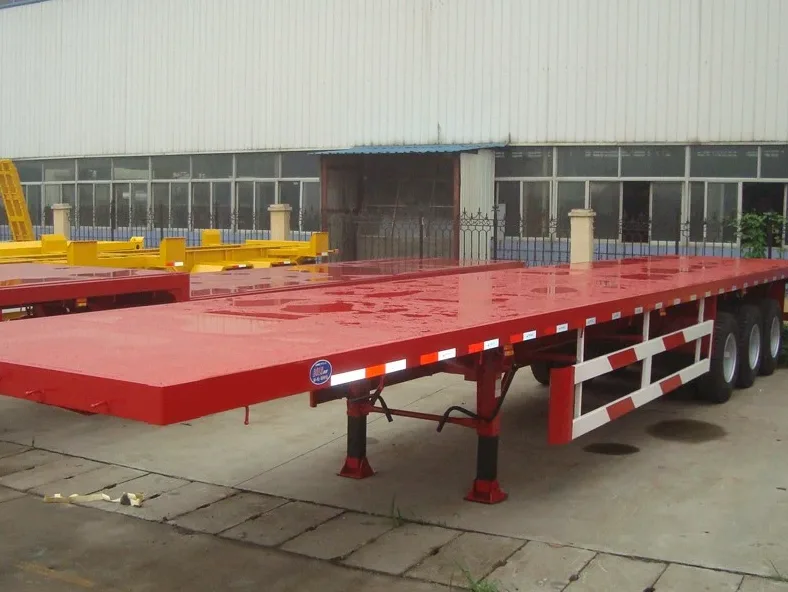
Width is the least negotiable of the three limits. Across our catalogue the working band is 96 to 102 inches — 2.44 to 2.59 metres — and most East and West African corridors treat 2.5 metres as the practical ceiling without a special permit. That band shows up everywhere: it is the deck width of a 48 ft flatbed at 102 inches, and the box width of our 28–53 ft box van line. When customers ask for wider decks, the conversation quickly becomes about escort vehicles and permits — which is why we solve for volume in length and height first.
Side-wall and fence bodies add their own wrinkle: the cargo boards stand inside the legal envelope, so a 1,800 mm wall height still leaves the same 2.5-metre footprint. That is the logic behind our side wall trailer lineup — the wall decision changes what you can stack, never how wide you can be.
Height: The Deck Sets the Budget
Height is where semi trailer dimensions become arithmetic. A bridge with 4.5 metres of clearance does not care how tall your cargo is — it cares about deck height plus cargo height. That sum is the height budget, and every trailer type spends it differently. A flatbed spends almost nothing: the load platform sits roughly 1.5 metres off the road, leaving the full budget for the cargo itself. A box van spends 12 to 13 feet of internal height — about 3.7 to 4 metres — to give palletised and bagged goods a weatherproof envelope.
The lowbed spends its cleverly: by dropping the main deck below the axle line, it recovers 600–900 mm of height compared with a flatbed — which is exactly why excavators and transformers ride on lowbeds.The trade-offs between the two deck heights, and the cargo classes that decide them, are covered in our flatbed versus lowbed comparison.
Axles: Turning Gross Weight Into a Legal Number
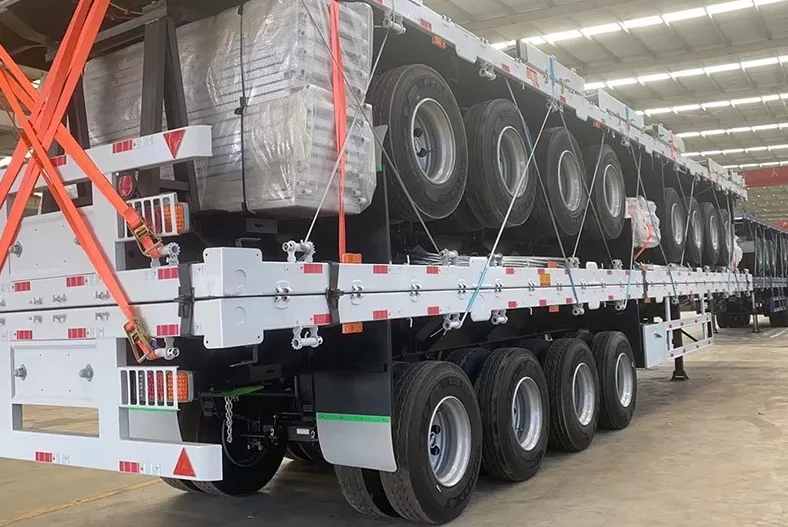
The fourth dimension is not written on a tape measure. Axle count converts your gross weight into something a corridor will accept. Our running gear is rated at 13 or 16 tonnes per axle, FUWA or BPW, so the maths is straightforward: two axles carry the 20–30 tonne class, three axles the 40–60 tonne class, four axles reach 80 tonnes, and five axles take the 100–150 tonne excavator builds on our 30–150 ton lowbed line. Where a route enforces a lower per-axle limit, the answer is not a lighter trailer — it is one more axle, which is how the 5-axle 100-ton lowbed exists at all.
Axle spacing and suspension type round out the calculation. Air suspension distributes load more gently across the span, keeping you within road regulations and safeguarding sensitive cargo; mechanical leaf springs, on the other hand, cost less to maintain on rough gravel.The questions worth asking before you choose are listed in our suspension cost-of-ownership breakdown, and the same weight-first logic scales all the way up to the modular heavy-haul platforms that bolt axle lines together for generating equipment and port machinery.
The Numbers We Need From You
When an inquiry lands without dimensions, our first reply is always the same: tell us your route. Five numbers turn a rough estimate into a firm quote — what the cargo is, its dimensions and loaded weight, how it is loaded, how many units, and the destination corridor.From there the dimension table resolves itself — length from the cargo footprint, width from the permit regime, height from the bridges, axles from the scales. If your route is still uncertain, hand the spec to our team via the inquiry form and we will propose two or three dimension sets against the corridors you expect to run.
Planning a fleet order and unsure which semi trailer dimensions fit your corridors? Send your cargo details and destination routes through our inquiry form or message us on WhatsApp — our engineering team will map length, width, height and axle count to your route and return a quotation within 48 hours.