Week after week, we receive the same lowbed enquiry: “4 axle lowbed semi trailer, FOB Qingdao.” Buyers often send this request without sharing the machine weight, cargo dimensions or loading approach. And the first reply from our engineers is always the same three questions, because “4 axle” on its own points at four completely different trailers in the lowbed lineup — an 80-ton unit, a 100-ton unit, a 120-ton unit and a 150-ton unit, each with a different main beam, a different deck and a different factory price.
This is the story behind those ratings: what the ton label actually fixes on a 4-axle build, what stays constant across the whole lineup, and how the loading question — ramps or gooseneck — splits the order sheet one more time.
What a Ton Rating Actually Fixes
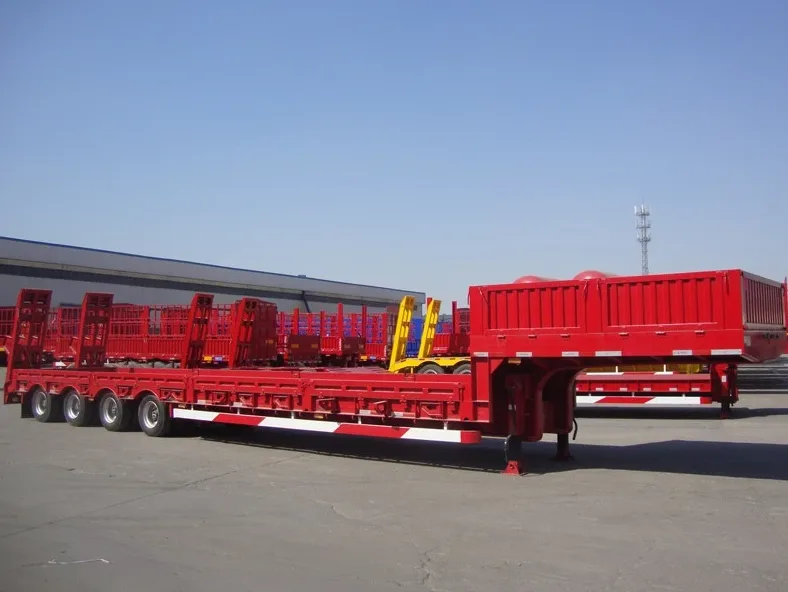
The axle count only sets the skeleton. Every 4-axle lowbed in the lineup runs FUWA or BPW axles, but those axles come in 13, 16 and 20-ton ratings — so four axles can legally carry anywhere from the low 50s to 150 tons before the frame, not the axle line, becomes the limit. The ton rating on the order is really a stack of three decisions:
- Main beam specification. The 4 axle 80 ton lowbed trailer carries a double-layer reinforced high-strength beam; the 120 and 150-ton ratings push beam thickness and reinforcement further, which is most of the price difference between ratings.
- Deck length and width. Custom deck lengths from 12 m to 16 m are available. Our standard 80-ton model features a 13,500 × 3,000 mm deck and an 850 mm loaded height. Extended deck widths up to 4,500 mm can also be specified for oversize steel structures and wide mining equipment.
- Tires and axle tonnage. The 80-ton build rides 16 tires on 12R22.5 rubber; heavier ratings move up the 16/20-ton axle options to keep per-axle load legal on the routes that matter.
The factory price range across the whole lowbed family runs USD 11,000–50,000, and the 4-axle 80-ton baseline lands at USD 14,000–28,000 depending on configuration — hydraulic gooseneck, widened deck, imported branded components, paint process and order quantity all move the number.
Four Load Ratings, Four Applications
| 4-axle build | Rating | Where it earns its keep |
|---|---|---|
| 80 ton excavator build | 80 t | 20–30 ton excavators, regular construction fleets, the volume seller |
| 100 ton build | 100 t | Heavier excavators and mixed mining equipment on mixed roads |
| 120 ton machinery build | 120 t | Heavy machinery relocation, crushers, drilling rigs |
| 150 ton build | 150 t | Oversized steel structures and bridge components, short heavy hauls |
Buyers who already know their machine weight usually pick in one step — a 25-ton excavator goes on the 80-ton build, a 40-ton mining excavator goes on the 120. Buyers with mixed fleets are often the ones stuck deciding. For these operators, our straightforward guidance: spec the trailer capacity around your heaviest regular load, not a one-off oversize shipment.
The Second Split: How the Machine Gets On the Deck
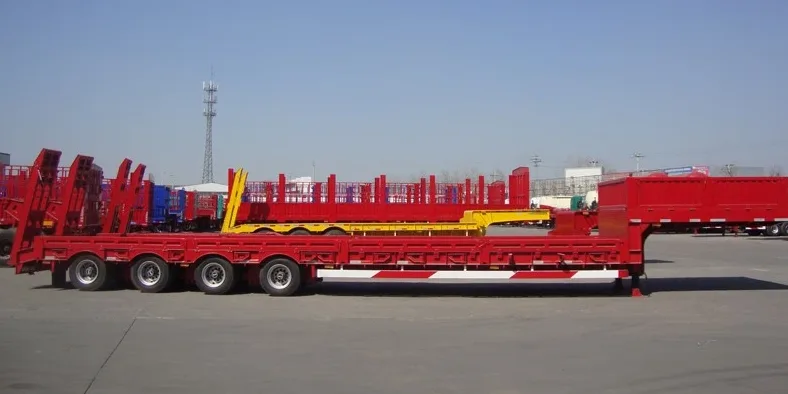
The ton rating is only half the order. The other half is the loading method, and it splits the lineup three ways. Self-propelled machines — excavators, loaders, graders — climb aboard over spring ramps on the standard fixed gooseneck build, with hydraulic ramps as the upgrade for heavier machines and rough loading grounds. Machines that must be winched or driven on from the front go on the 4 axle detachable gooseneck build, where the neck drops to the ground and the deck becomes a ramp itself — the lowest possible loading angle for the tallest cargo. And the high-low-high configuration keeps the rear section low for wheeled machines while the front carries taller loads.
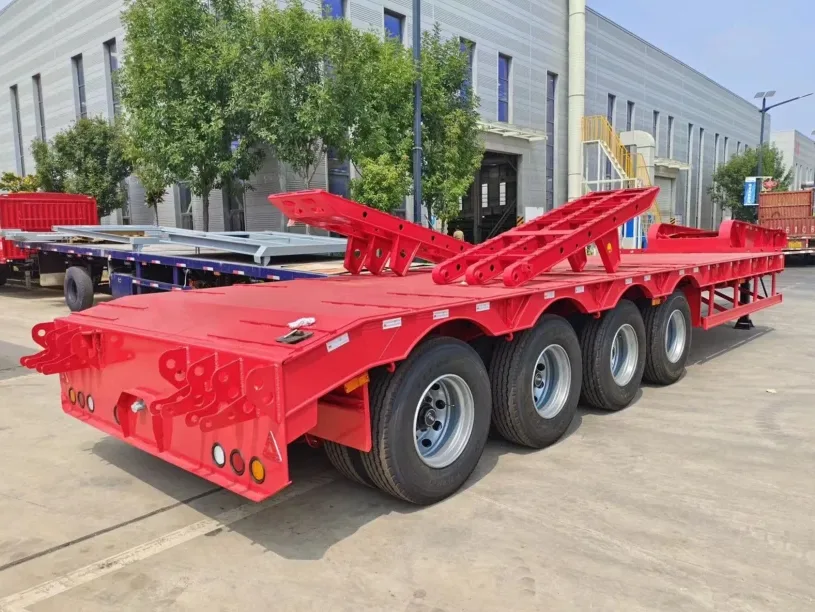
Our 2026 catalogue covers the remaining configuration choices: mechanical or air suspension, steerable axles for narrow mine routes, widened components, plus open or enclosed tire layouts. None of these features come as standard. Each is a separate quoted item, which explains why two orders labelled “4 axle 80 ton” can have a price gap of ten thousand US dollars.
What Stays Constant on Every Build
Underneath the rating differences, the lineup shares the parts that decide whether a lowbed is still working in year five:
- Submerged arc welded main beams — fully automatic welding on the beam, experienced welders reinforcing every critical stress joint, welds full and deeply penetrated.
- WABCO dual-circuit braking with ABS across the lineup, matched to a heavy-duty tractor of 420 HP or above.
- JOST King Pin: 2″ or 3.5″ Options and landing gear rated from -30°C to 120°C.
- Polyurethane combination painting after full surface pretreatment — film reaches corners and weld seams the single-coat shops miss.
These fixed fundamentals explain why we start every order form with load capacity and loading method, before moving to other details — these two factors shape the core build of the trailer.
Who Runs These Trailers
The 4-axle ratings earn their keep on the corridors where heavy machines move: about 500 lowbeds leave for Ghana every year, a Philippine fleet that started with a two-unit trial order in 2018 now takes 300 units annually, a Nigerian operator has ordered ten units every month for eight years running, and Kenyan construction fleets reorder on the same pattern. The ton ratings differ across those markets — mining corridors buy heavy, construction fleets buy the 80-ton baseline — but the order questions are identical everywhere.
If you are weighing how a 4-axle lowbed fits against the rest of the heavy-haul family, the flatbed trailer types walkthrough covers the full deck-height spectrum, and the 100 ton lowbed buying guide breaks down the axle math from the buyer’s side.
Information to Include in Your Inquiry
A 4-axle quote comes back accurate and fast when the inquiry carries five things: the machine weight, the machine dimensions (length, width, height), the loading method (self-propelled, winched, or front-loaded), the route limits (bridge and road restrictions on your corridors), and the destination port. From there the ton rating, deck length and gooseneck choice fall out of the spec in one reply — engineers respond within 24 hours, send your machine list through the contact form and the configuration lands in your inbox the next day.
Specifying Your 4-Axle Lowbed Semi-Trailer? Send the machine weight and dimensions and get a factory-direct quote with the ton rating, deck spec and loading configuration in one document — request it through the contact form or message us on WhatsApp. VEHICLE MASTER builds 20,000+ trailers annually and replies to every spec sheet within 24 hours.