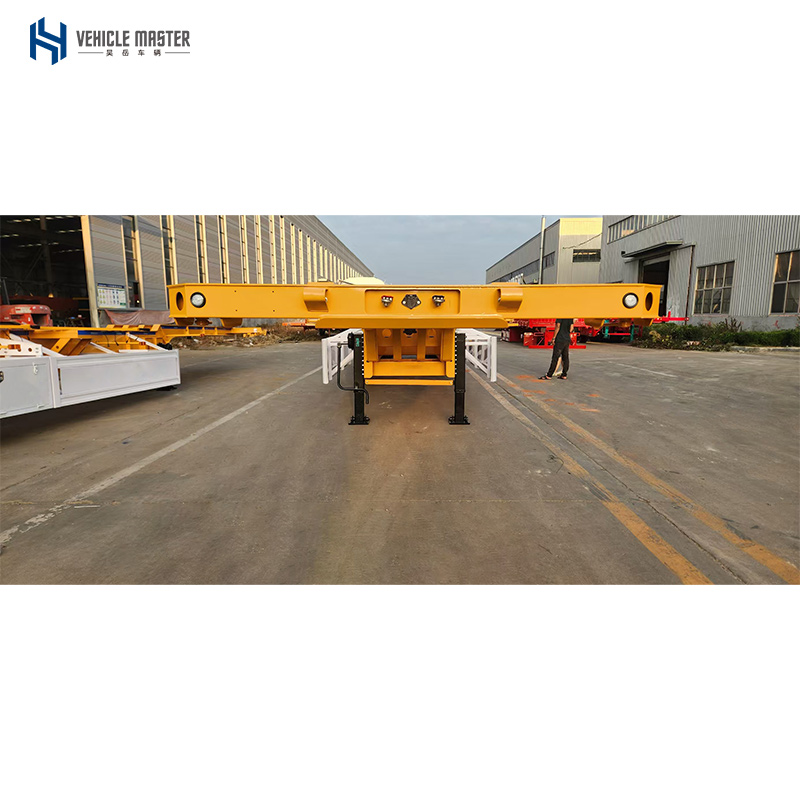
Pull up the enquiry inbox of any container trailer manufacturer on a Monday morning, and you will spot this same piece of equipment referred to by five different names well before midday. One buyer asks for a skeleton trailer. The next writes skeletal truck. A fleet manager in Mombasa says container chassis, his counterpart in Lagos says container lorry, and a procurement officer in Jakarta simply types skeletal semi trailer into the search box and clicks whatever loads first.
All five are ordering the same machine: a bare ladder-frame semi trailer whose only cargo is the corrugated steel box that locks onto it. The names do not change the build — but each name tends to come from a buyer at a different stage of the decision, asking a different question. This article lines the vocabulary up against the hardware, so that whatever your team types, you know exactly which spec is hiding behind it.
Why One Trailer Answers to Five Names
Skeleton and skeletal are simply two spellings of the same adjective — the trailer is a skeleton because everything not needed to carry a container has been removed. Skeleton trailer and skeletal trailer refer to the same engineering design; the difference in spelling usually just reflects the buyer’s regional English usage. Container chassis is the intermodal term used at ports and rail terminals, where the frame is seen as the rolling chassis that a box sits on. Container lorry is Commonwealth usage across East and West Africa and South Asia, where lorry covers almost any rigid or articulated goods vehicle. And in North American corridors the same concept surfaces as the platform wagon or skeletal wagon order that keeps ports moving.
At the quotation desk, none of this matters. A buyer from any of those regions who wants to source a 20/40/45ft skeletal truck semi trailer receives the same specification sheet — what actually changes the quote is the frame length, the axle count and the container lock layout, which we will get to.
When Buyers Type “Skeletal Truck,” They Usually Mean the Whole Rig
The word truck in the search box is doing real work.Buyers looking for a skeletal truck seldom want just the trailer itself. They are usually getting quotes for the full rig: a 6×4 tractor paired with a skeleton trailer, as this is the typical way container transport packages are purchased across most emerging markets. The trailer leaves our plant, the tractor comes from a domestic dealer, and the two have to agree on three interfaces before the rig turns a wheel.
First, the king pin: skeleton trailers are built with either a 2-inch or a 3.5-inch pin, and the fifth wheel plate on the tractor must match. Heavier 40ft and 45ft operations standardize on the 3.5-inch pin. Second, the laden weight the combination must legalise: a 3-axle skeletal carrying a loaded 40ft box typically scales near 40 tonnes of payload capacity against roughly 6 tonnes of trailer tare, so the tractor’s drive-axle rating and the bridge formula of the operating country decide whether 3 axles are enough or a 30–80 ton skeleton truck trailer spec with 4 axles is the safer order. Third, the landing gear — a JOST 28-ton two-speed unit is standard, sized so the front of the frame does not sag when the rig is dropped in a yard without pavement.
So if your team reaches out to a manufacturer asking about a skeletal truck, be sure to specify the tractor details: horsepower, axle layout and fifth wheel height. The factory engineers match the frame’s gooseneck and pin to that tractor, not the other way round.
The Beam Behind All The Names: T-Frame and Through-Beam Designs
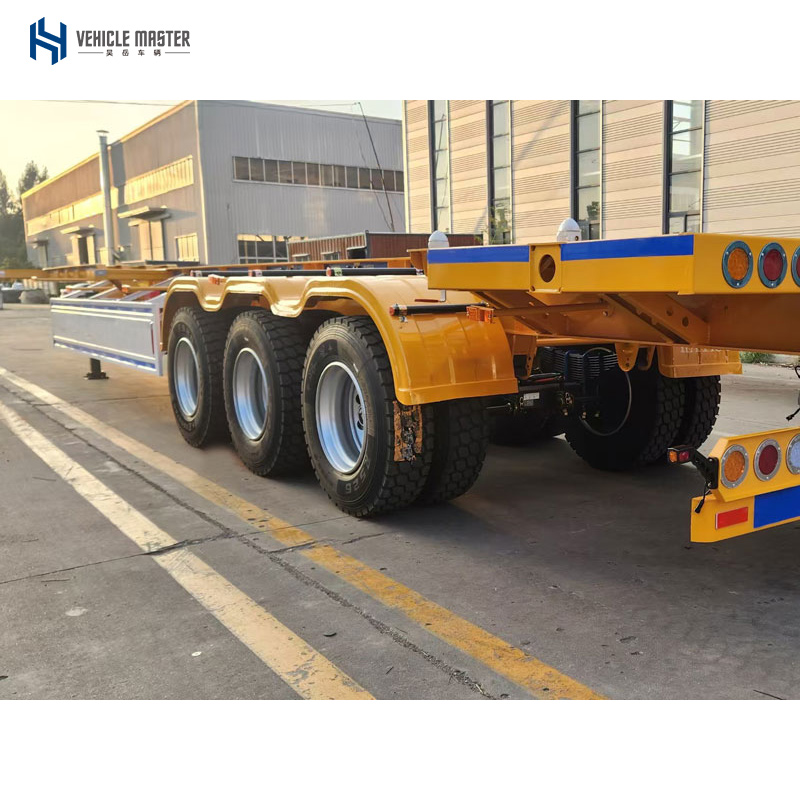
Strip the names away and every skeletal semi trailer is one of two structures. The conventional build runs twin I-shaped main beams — 16Mn steel plate submerged-arc welded into a section roughly 450 to 500 mm high — with cross members between them, and the container locks sitting on the flanges. The alternative is the through-beam skeletal semi trailer, where a single transverse beam passes through the frame at each lock position, carrying the container’s corner castings directly.
The through‑beam design adds some fabrication complexity, yet delivers superior structural integrity and a lighter chassis. For a 12400 × 2500 × 1590 mm skeleton chassis, this brings a tare weight of roughly 6 tonnes, with a maximum payload of 40 tonnes.That gap is money: every kilogram of frame you do not haul is a kilogram of legal payload you can invoice. For fleets running dense corridor work at the weight limit, the beam decision is worth more than any badge on the trailer.
Match the Frame Length to the Boxes You Actually Haul
Frame length is not a preference — it is arithmetic, dictated by the containers your corridor offers. The factory builds the three standard lengths on one line:
| Frame | Dimensions (L×W×H) | Axles | Twist locks | Box combinations |
|---|---|---|---|---|
| 20ft | 7000 × 2480 × 1560 mm | 2 or 3 × 13t | 4 sets | 1 × 20ft |
| 40ft | 12400 × 2480 × 1580 mm | 3 or 4 × 13t | 12 sets | 1 × 40ft / 2 × 20ft |
| 45ft | 13950 × 2500 × 1600 mm | 3 or 4 × 13t | 12 sets | 1 × 45ft / 1 × 40ft / 2 × 20ft |
Read the last column like a route plan. The 20ft skeleton frame works well for port shunting and urban delivery, ideal for jobs hauling just one tank container or a standard 20ft shipping box.The 40ft frame is the continental default — one forty or two twenties on the same locks, which is what makes 2–3 axle skeletal semi trailer orders so common on trunk corridors. The 45ft frame adds the high-cube 45ft boxes favoured on routes where one extra foot of container means one extra pallet position of revenue.
If your box mix genuinely varies week to week, say so in the inquiry — a 12m skeletal trailer can be laid out for mixed 20/40ft work, and the lock positions are set at the factory to the combinations you name, not adjusted later in a yard.
One Frame for All Container Sizes: The Extendable Skeletal Trailer
There is one variant that deliberately refuses to pick a length. The extendable skeletal trailer telescopes its frame between 20ft and 45ft lock positions, mixing steel structure with aluminium panels to hold tare weight down, and rates around 50,000 lbs of payload on 2 or 3 axles. Fleets that win irregular contracts — one month drayage, the next month 45ft high-cubes — pay the premium for one trailer that reconfigures instead of three trailers that idle. The trade-off is honest: more moving structure means more inspection points, and the pivot wear zones deserve a place on the maintenance schedule.
Where the Axle Conversation Starts
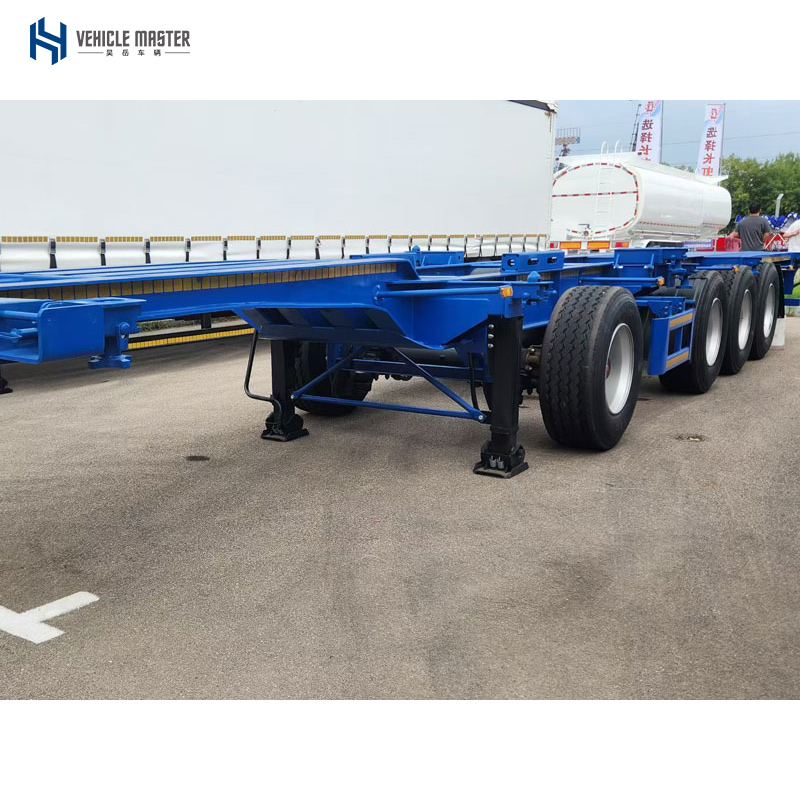
No matter what name you use for it, the axle calculation stays the same: 13‑tonne or 16‑tonne axles from FUWA, BPW or our in‑house Vehicle Master range. Multiply the axle rating by axle quantity, then subtract the tare weight.Three axles carry the standard loaded 40ft box; two axles buy lower tare and purchase cost for 20ft work; four axles legalise heavy or stacked configurations on routes that permit them. We have written the full payload math, lock layout and cost logic in a separate guide — Tri-Axle Skeletal Trailer: Payload Calculations for 2-Axle, 3-Axle and 4-Axle builds — because buyers comparing axle counts need numbers, not adjectives.
The Constants Behind Any Name
No matter what term the buyer uses, our quotation team works from a consistent base specification. It includes Q345 or T700 grade steel for the main beam, electrophoretic primer applied prior to topcoat paint, WABCO-standard ABS or EBS brake systems, and heavy-duty mechanical leaf suspension as the standard option. Air suspension is available when cargo protection is required. The suspension geometry is engineered to resist wear and hold the tyres aligned correctly even under a fully loaded container.These constants are why a chassis order is less risky than it looks — the variables are only frame length, structure type, axle count and lock layout, and each of those has now been described. If you are unsure which baseline fits your corridor, hand your route and box mix to our engineers through the inquiry form and the specification comes back marked line by line.
How to Name Your Order in the Inquiry
Put simply, this is what it means for your enquiry. Don’t get stuck debating whether to call it skeleton or skeletal — just tell us which containers you need to haul. An inquiry that says “1 × 40ft and sometimes 2 × 20ft, tractor is a 6×4 with 3.5-inch fifth wheel, route is Mombasa to Kampala, 12 units” produces an exact quotation in one reply, while a two-week exchange about terminology produces a catalogue. The port-corridor volumes behind container chassis demand keep rising, and the buyers who win delivery slots are the ones whose specs arrive complete.
The same applies if your market calls it a lorry — our container lorry lineup walkthrough shows how African fleets phrase exactly these orders in practice.
Ready to get a quotation for your container chassis, no matter what name you use for it? Send your box combinations, tractor specification and destination port through the inquiry form, or message our team directly on WhatsApp. Vehicle Master reviews every configuration and replies with a specification-matched quotation.