Two inquiry sheets land on the same desk in the same week. Both ask for a skeletal trailer for 40ft container runs out of the same port. One gets quoted a tri-axle skeletal trailer; the other gets a two-axle chassis with a lower price and a lighter tare. Buyers may initially see this as merely a sales recommendation, but that is not the case. For container skeletal trailers, axle quantity is rooted in calculations long before it becomes a choice. Once you learn how to work out these figures, the quotes you get will be far easier to understand.
This guide walks through that arithmetic the way our engineering desk does: axle ratings first, tare weight second, twist lock layout third, and only then the optional equipment that separates one order from the next.
The Axle Math Comes First
Every skeletal trailer we build rides on FUWA or BPW axles rated at 13 tons standard or 16 tons reinforced. That single number sets the ceiling for everything above it. Take the combined axle rating, subtract the chassis tare, and what remains is the realistic container weight the trailer can legally carry:
| Configuration | Axle rating | Tires | Realistic payload | Best fit |
|---|---|---|---|---|
| 2 axles (tandem) | 2 × 13t | 8 × 12R22.5 | ~20–24t | 20ft loaded boxes, light 40ft runs |
| 3 axles (tri-axle) | 3 × 13t | 12 × 12R22.5 | ~30–34t | Loaded 40ft containers, mixed terminal work |
| 4 axles | 4 × 13t or 16t | 16 × 12R22.5 | 40t and up | 45ft boxes, heavy tank containers, dual 20ft |
The reference build in our through-beam skeletal semi trailer line shows the tri-axle midpoint plainly: 6,000 kg tare against a 40,000 kg maximum payload. A fully loaded 40ft container carrying 26–30 tonnes of cargo fits safely within weight limits on a three-axle setup, yet exceeds the allowable threshold with two axles. This is why tri-axle skeletal trailers are such a reliable workhorse option: they are engineered for the real-world containers shipped globally, not just idealised tariff figures.
Why 3 Axles Are the Standard Choice for 40ft Containers
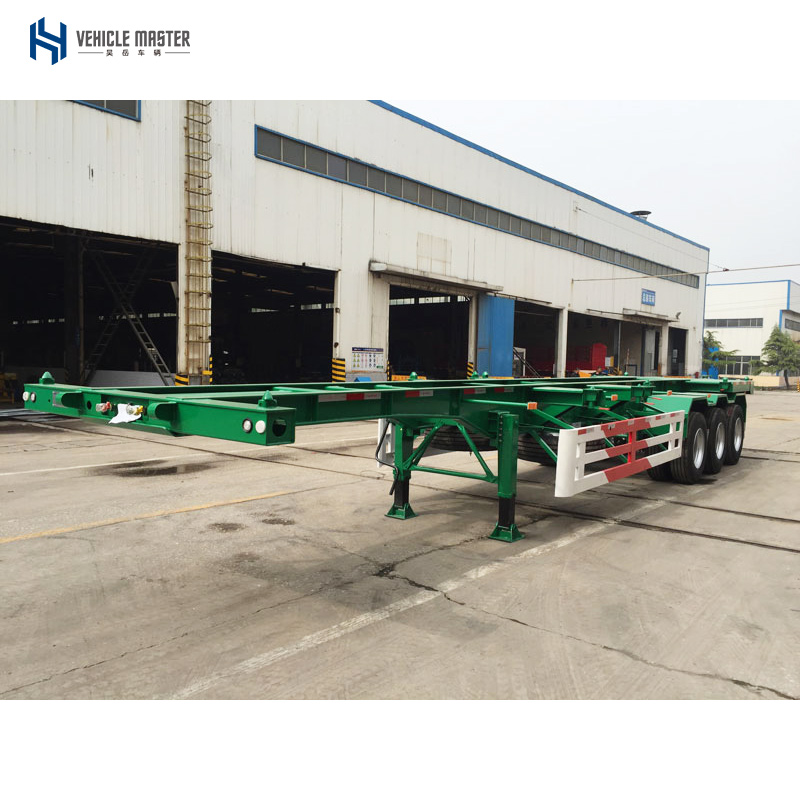
Payload is only half the story. The other half is how the weight reaches the road. A loaded 40ft container concentrates its mass between the kingpin and the rear bogie, and bridge formulas in most markets punish concentration. Spreading the same load across three axles instead of two drops the per-axle transfer, softens what the rear suspension has to absorb, and keeps the load legal on corridors where a tandem chassis would be over the line.
On our 2–3 axle skeletal semi trailer platform, that shows up in the hardware: 12 tires instead of 8, leaf springs stepped from 90×13mm to 90×16mm packs, and an anti-tire-abrasion suspension geometry that keeps the twelve tires tracking straight under a full box instead of scrubbing the shoulders off the rear pair.Braking performance also increases alongside axle count. Dual-line air brake systems fitted with WABCO valves and ABS are supplied as standard, since a 34-tonne moving load requires greater stopping power than a 20-tonne load.
For buyers weighing the step up, the 40ft skeletal semi trailer spec sheet lists the full family at 20–80t across 2/3/4 axle configurations, which is the cleanest way to see how each axle added moves both payload and price.
Twist Lock Layout Follows Length and Axle Count
Once the axle count is fixed, the locking plan almost writes itself. our to twelve ISO twist locks are arranged along the chassis frame, aligned to the container corner castings. Four locks serve a single 20ft container position, eight are used for one 40ft container or two 20ft containers, and twelve are fitted for frames carrying a 40ft container with overhang or 45ft containers. More axles usually mean a longer, stronger frame — and a longer frame earns more lock positions.
The special case is the mixed fleet. Operators who alternate between a 20ft cement tanker box one week and a 40ft general cargo box the next often spec the extendable skeletal trailer, whose telescopic frame adjusts between lock positions instead of forcing one container size forever. For fixed 45ft and tank container work, the extra length rides on four axles — our 4-axle 45ft skeleton trailer for cement is the typical build.
What Every Axle Count Shares
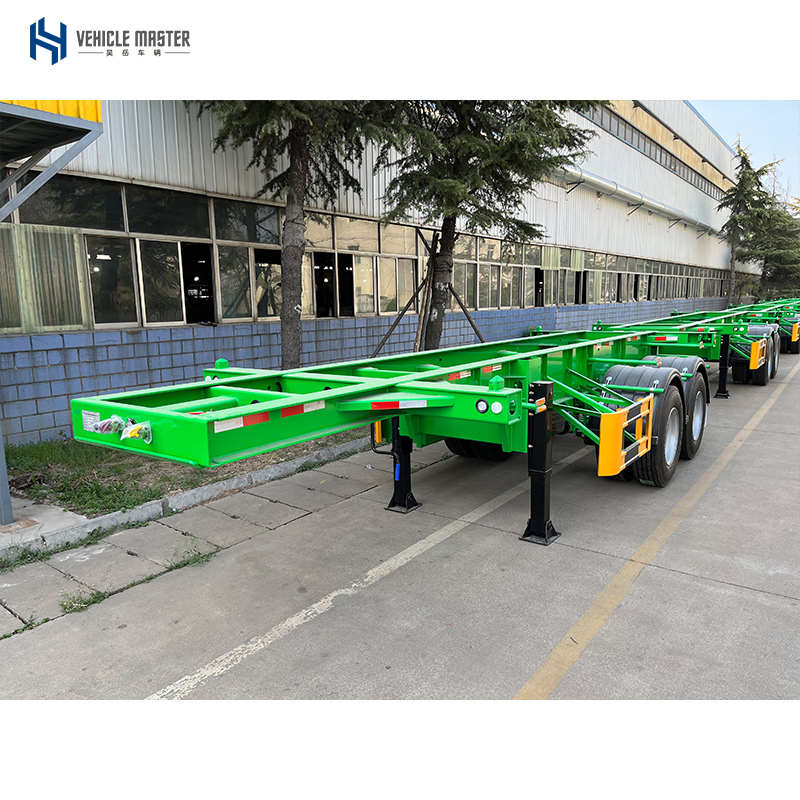
Under the axles, chassis specs differ little between 2‑axle and 4‑axle orders; this consistency is by design:
- Main beam: Q345B/T700 high-strength steel I-beam, sized for bending and compression resistance on rough port approaches.
- Landing gear: JOST-type 28t two-speed landing legs, rated -30°C to 120°C, suitable for both cold highland winters and hot dockside summers.
- Kingpin: #50 (2″) or #90 (3.5″) to match the tractor fleet, not the trailer.
- Electrics: moisture-proof LED lamps and copper-sealed connectors on every circuit — no rust, no air leakage, no roadside rewiring.
- Paint: electrophoresis dip before the topcoat, which is the difference between a chassis that survives coastal salt air and one that rusts from the inside out.
The intermodal container chassis trailer page carries the full constant specification, including the port and terminal guide-rail and post options that make sense only for yard shuttling — worth reading before you pay for equipment a long-haul run will never use.
When 2‑Axle or 4‑Axle Skeletal Trailers Are the Better Fit
Tri-axle is the default, not a rule. Two axles earn their keep on light or empty repositioning work: a terminal hauling 20ft boxes short distances burns less fuel and less toll money on a tandem chassis with an 8-tire footprint. The tare saving alone — roughly a ton or more against a tri-axle frame — pays for itself on tariffed corridors.
Four axles answer the opposite problem. A 45ft box loaded to the corners, a tank container at 30t+ of product, or a dual-20ft load stacked heavy all push past what three axles distribute legally. That higher upfront purchase cost pays for itself by keeping you compliant on routes where weight scales issue overload penalties instead of just verbal warnings.We broke down how those route limits interact with trailer dimensions in an earlier guide on semi trailer dimensions and route limits.
Five Numbers to Send With Your Inquiry
A skeletal trailer quote is only as good as the numbers behind it. Whatever the axle count, five figures settle the configuration faster than any back-and-forth:
- The container sizes you actually move — 20ft, 40ft, 45ft, or a mix.
- Maximum loaded container weight (tonnes), cargo included.
- The tare budget your tariffs or bridge rules impose.
- The corridor: port-to-yard shuttle, cross-border long haul, or mixed.
- Destination port and delivery terms, to include 40ft HC or bulk shipping cost in the order pricing.
Hand those five to our team through the inquiry form and the axle count resolves itself in the first reply — usually with two or three priced options across the 2/3/4 axle range so the trade-offs are visible side by side. The wider context on how port corridors across Africa are shifting fleet orders is covered in our pieces on container chassis demand and the 40 foot platform wagon market; for the lorry-side vocabulary many Commonwealth buyers use, see the container lorry lineup guide.
If you are selecting a skeletal trailer and uncertain whether a two‑axle, three‑axle or four‑axle model matches your load requirements? Send us your container sizes, heaviest box weight and destination through the contact form, or message us on WhatsApp — our engineering team will return a priced configuration across all viable axle counts, straight from the factory.